
“A balloon about to rise from the ground encircled by three tiers of galleries or narrow platforms, protected by railings. Behind the railings sit the passengers. In the highest tier are three ladies notorious at that time for their amours …: Grace Elliott or Eliot, née Dalrymple, known as ‘Dally the tall’, she holds a fan, turning her head in profile to the left, towards Perdita (Mary Robinson), who clasps her hands ecstatically; Lady Worsley sits on the right. In the centre gallery sit ex-ministers: North (left) and Fox (right) in the centre, North’s arm on Fox’s shoulder; Fox turns his head to North with an expression of satisfaction. Each rests his right hand on the railing in front of him, and these hands hold an inconspicuous thread which is attached to the nose of the Duke of Portland (left), who turns in profile to the right. On the right, a little apart, sits Burke dressed as a Jesuit (see British Museum Satires No. 6205) looking in profile to the right towards the Pope, who stands on the gallery, emerging from behind the curve of the balloon. He wears furred robes and his triple crown; as a pendant to him on the extreme left is the Devil looking towards the ministers with a pleased expression; over his arm he holds a net. In the lowest gallery sit celebrated quacks and other London characters. These are (left to right) “Vestina’, the goddess of Health who advertised the virtues of the celestial bed (incorrectly said to have been Lady Hamilton), sits next her employer, Dr. Graham; they look at each other; she holds a sceptre wreathed with a garland. Jeffery Dunstan, Mayor of Garrat, stands, knock-kneed, with his sack over his shoulder in his accustomed attitude when calling ‘old wigs’. Sam House sits resting a foaming tankard of porter on the railing in front of him, the tankard inscribed “House Ward[our] Stre[eet]”. Katerfelto, turned in profile to the right, gazes up at the moon through his telescope; in his left hand is a paper, “Wonders, Wonders Most Wonderfull Wonders”, the usual heading of his advertisements, cf. British Museum Satires No. 6162. His black cat sits on the railing facing him, saying, “are there Mice in the Moon Master”. In the upper right corner of the design is the moon, a crescent-shaped profile inset in a circle, looking down at the balloon. The balloon is encircled longitudinally by eight ropes which meet in a knot beneath it and are there attached to four stouter ropes attached to the four corners of a platform which rests on the ground, from which the balloon appears about to ascend. On this platform is a tub inscribed “Vanity”, bubbling over with soapsuds inscribed “Froth”. Beside the platform (right) stands a Frenchman capering on one leg and flourishing a knife. He says, “Oh Begar dis be von fine Cargo.” … In the background are the roofs and spires of London, St. Paul’s being prominent on the left, the Monument on the right. …”–British Museum online catalogue.
- Creator: Nixon, John, -1818, attributed name.
- Title: The aerostatick stage balloon [graphic] : Setts out from Swan with two Necks Lad Lane every Monday Morg. / Hanibal Scratch del.
- Publication: [London] : Pubd. Decr. 23, 1783, by Wm. Wells, No. 132 Fleet Street, [23 December 1783]
783.12.23.01+
Acquired May 2024

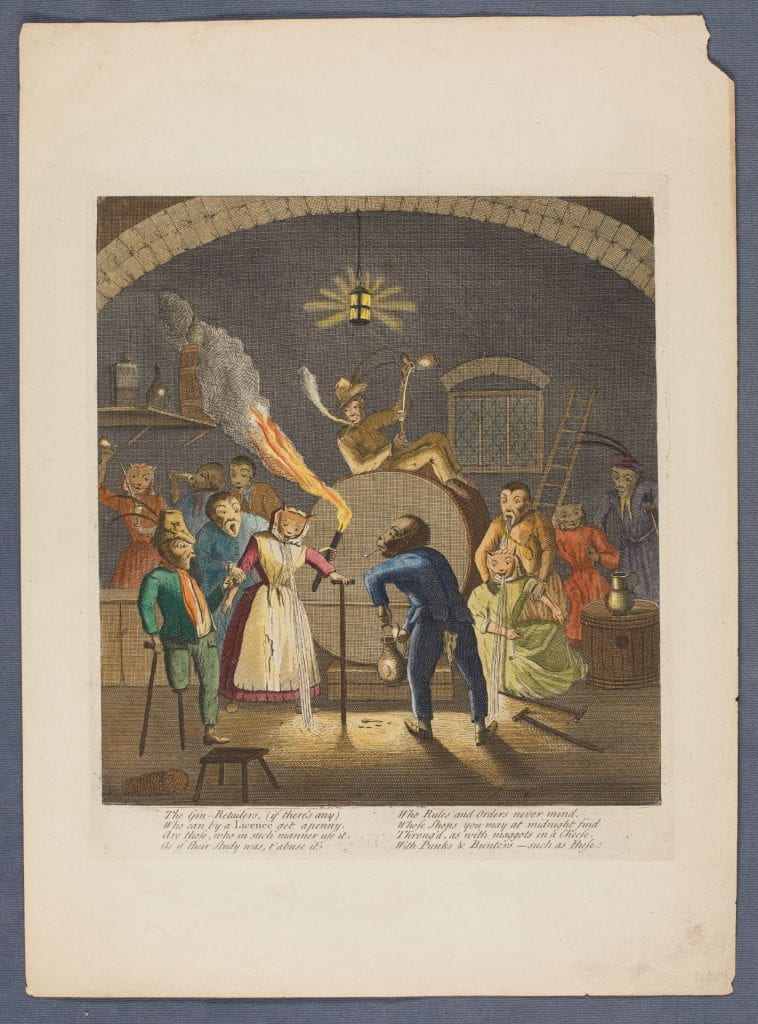
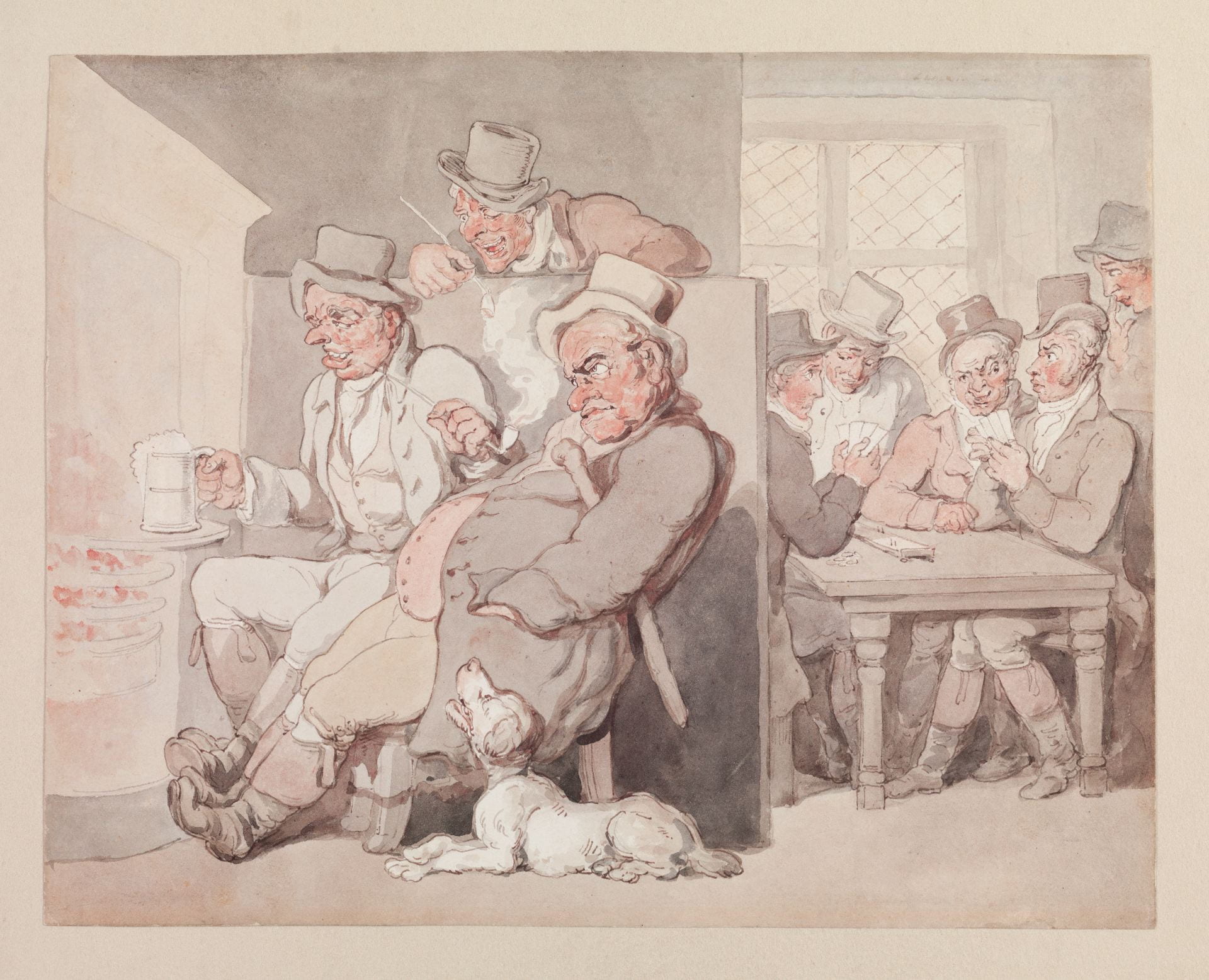
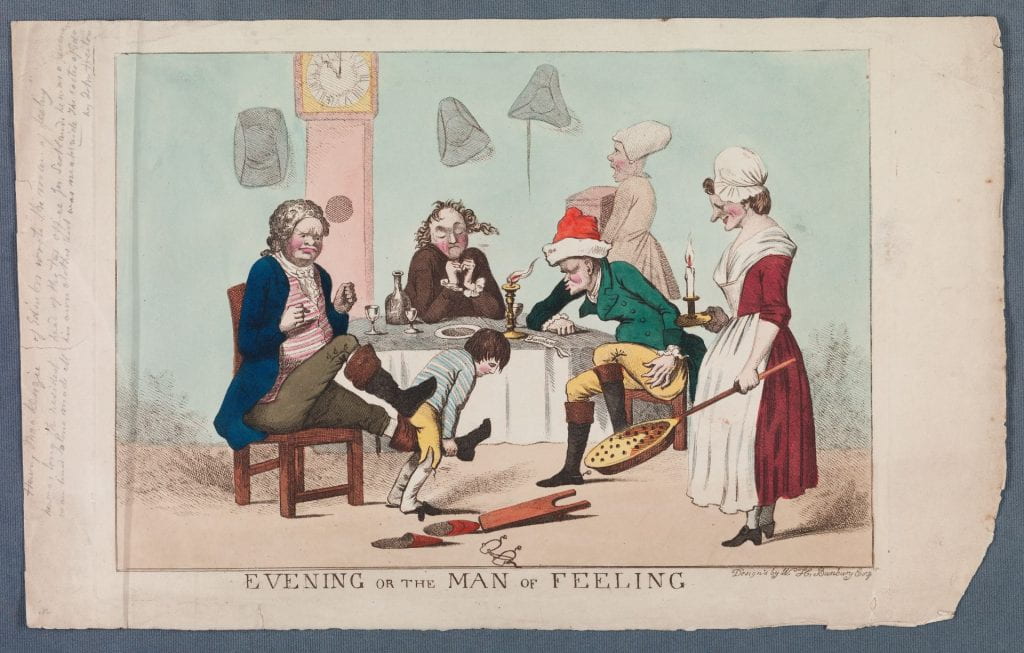 Three men sit by a supper-table, a grandfather-clock behind them points to XI. The man on the left is having his jack-boots pulled off by a small boy; the boy stands astride his right leg pulling hard, his back to the man, who is scowling and pushes his other booted foot against the boy’s back; on the floor are a pair of spurs, a pair of slippers, and a boot-jack. A man (right) wearing a night-cap, but otherwise completely dressed and wearing spurred boots, leans one elbow on the table, his face contorted as if in pain, he holds his hand to his thigh. On the table beside him is a small packet inscribed “Diaculum”. In the centre, and on the farther side of the table, the third man leans both elbows on the table, his hair is tousled and his eyes are shut. A servant behind, yawning, is carrying off a square box, probably a wig-box, while a maidservant stands on the right, a candle in one hand, a warming-pan in the other, watching with amusement the efforts of the boy to pull off the boot. Three hats hang on the wall; a bottle, a plate, three wine-glasses, and a guttering candle, burnt down to the socket, stand on the table. See related image in the British Museum catalogue.
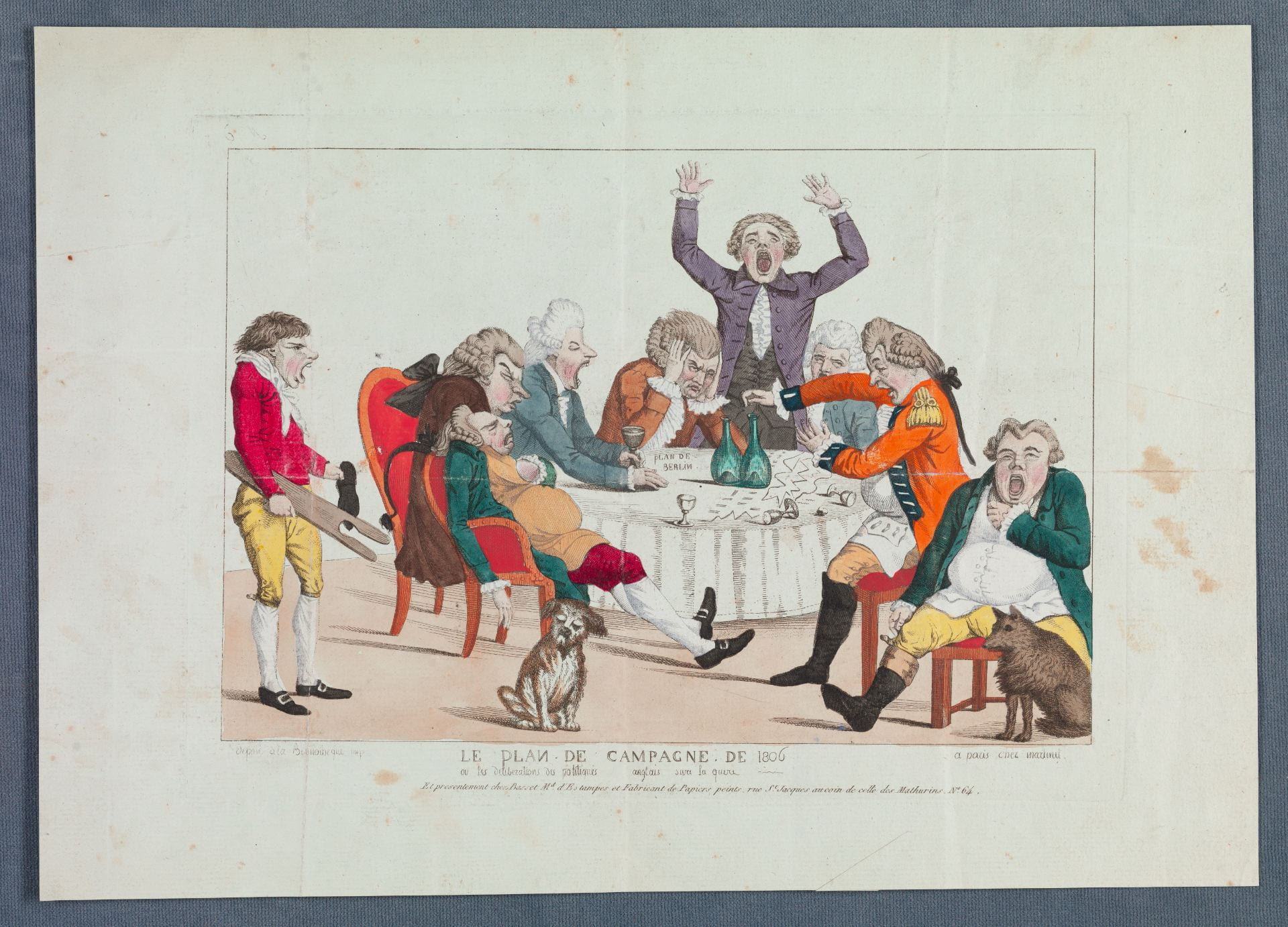
 The Coalition ministers are gathered around the table placed in the mouth of a cave. On the left sits Lord North wearing armor under his cloak, a goblet in his left hand. Opposite him on the right is Charles Fox, dressed as a centurion and sitting on a fox. He leans on the table keeping his right hand on three dice signed, “Madras,” “Bombay,” and “Bengal,” and clutching a dice box in his left. Behind him Admiral Keppel, the date of the battle of Ushant (1778) on his helmet, raises his goblet in a toast. Behind him Sheridan, with ass’s ears and “School for Scandal” written across his head cover, watches the Duke of Portland count out money to Lord Carlisle. On Portland’s shoulder leans Lord Cavendish in a centurion’s armor under his cloak. Between him and North sits Burke in a Jesuit’s outfit reading his own “Plan of oeconomy [sic].” Under the table lie the corpses of Lords Shelburne and Ashburton, ousted by the Coalition.
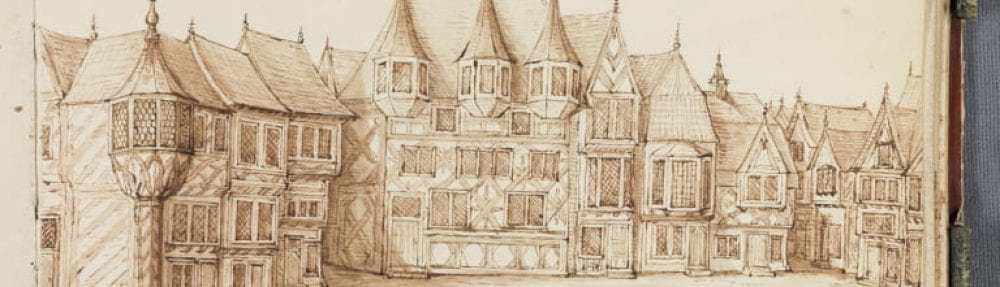
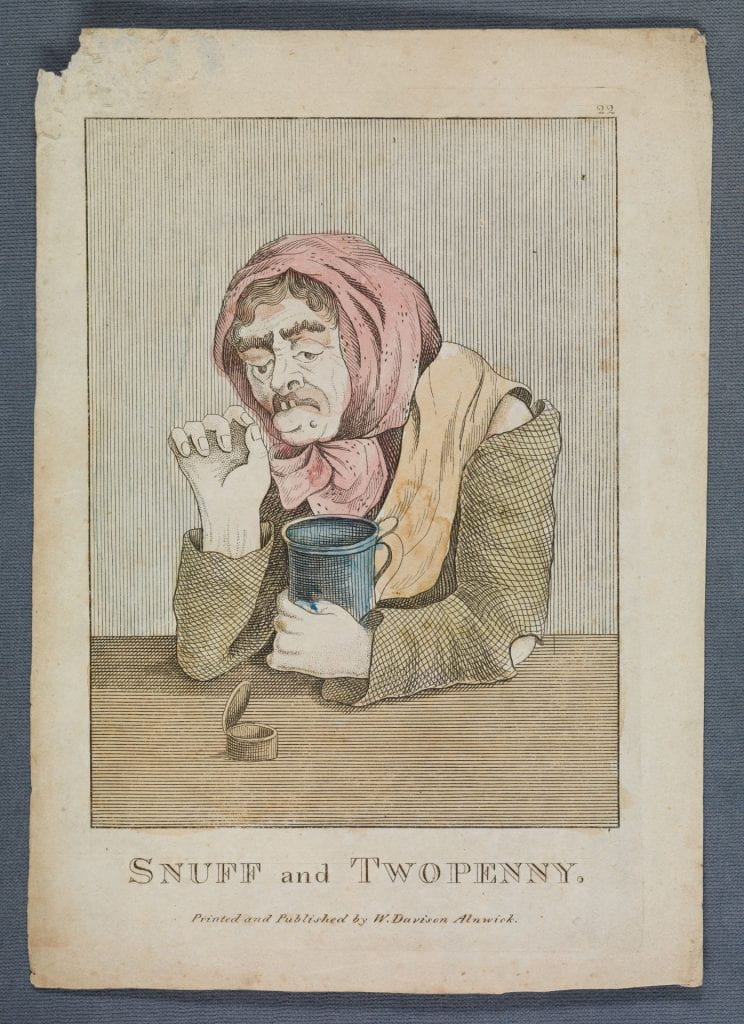
 A gentleman is shown half-length in profile to the right, pressing a walking stick to his chin and holding his hat under his arm; he stands in a disconsolate manner at table on the right on which are set tankard lettered “small beer” and paper “W. Davison druggist Alnwick sells”.