
“The Queen (right) and Mrs. Wood, a stout virago and a lean one, fight, clutching each other’s hair. The Queen’s large feathered hat is on the floor. A curtain is draped on a pillar (right), and from behind a curtain on the left, Alderman Wood, wearing his furred gown, watches the fray, drooping apprehensively; he says: “He Jests at Scars who never felt a wound!” Mrs. Wood: “I’ll teach you to play at Bergami with my Husband indeed–no–no I’ve read Jane Shore, & knows how things goes on in Courts, & Palace’s, in Como’s [cf. British Museum Satires No. 13857], Virgin’s Waters, Cottages, Pavilions, Yachts, & such like. An Honest Citizen has no business in such bad place’s & I’ll Tear your Eyes out before you shall make a Bergami of him.” The Queen shrieks: “Avaunt ye Termagant I’ll stop the Tongue of Slander & Level to the Dust, the proudest Foe that dares suspect my Chastity I’d tear you limb from [sic] tho you be made of Wood.” Behind, on a small chimney-piece, is a bust, perhaps that of Lady Craven.”–British Museum online catalogue.
- Printmaker: Heath, William, 1795-1840, printmaker.
- Title: Brandenburgh House theatricals [graphic] : a wood scene in a new farce now performing with the greatest eclat at the Hammersmith Theatre.
- Publication: [London] : Pub. Sep. 20, 1820, by S.W. Fores, 41 Picadill [sic], [20 September 1820]
820.09.20.01+
Acquired June 2024


 “Bonaparte (left) and Cornwallis play chess. Bonaparte, not caricatured, alert and military, wearing his large plumed cocked hat, leans forward, pointing to his move; his left arm lies on the table and in his left hand is his sheathed sabre. He says: “Check to your King, remember it is not the first time, and I think a very few Manœuvres more will completely convince you that I am better acquainted with the Game I am playing than you are aware of.” Cornwallis, plump and civilian despite his regimentals and profession, sits without a hat, scratching his head apprehensively. He says: “Curse it I shall lose this Game; You are too much for me.” He wears his ribbon and star, ‘Honi soit’ on his garter. The chairs are symbolical: that of Bonaparte has ormolu laurel wreaths, the legs are formed of fasces and axes; that of Cornwallis, with plain oval back, suggests an English drawing-room.”–British Museum online catalogue.
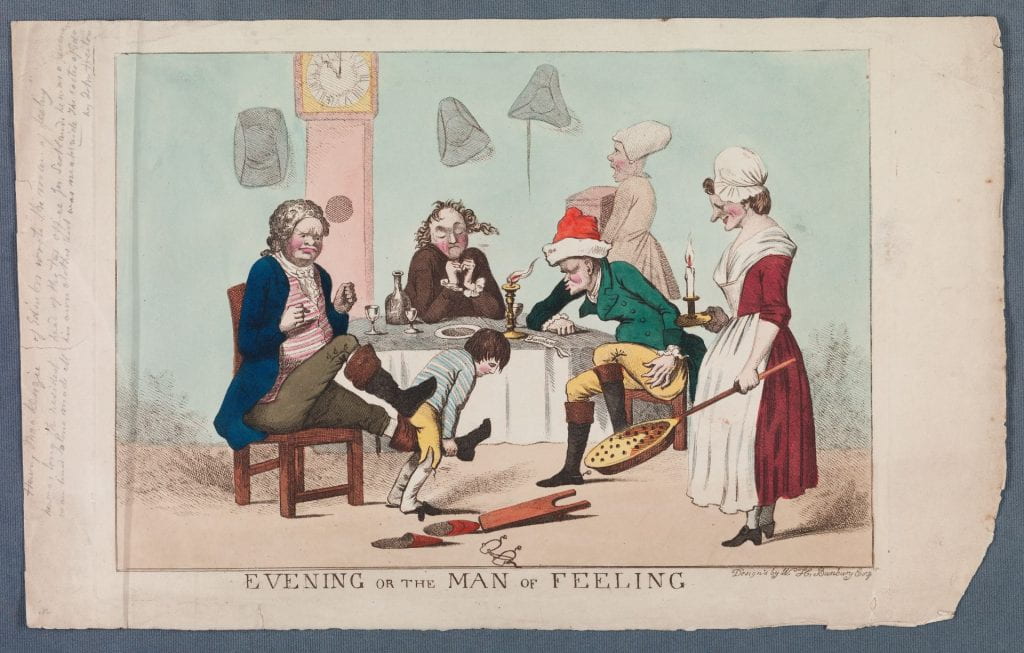 Three men sit by a supper-table, a grandfather-clock behind them points to XI. The man on the left is having his jack-boots pulled off by a small boy; the boy stands astride his right leg pulling hard, his back to the man, who is scowling and pushes his other booted foot against the boy’s back; on the floor are a pair of spurs, a pair of slippers, and a boot-jack. A man (right) wearing a night-cap, but otherwise completely dressed and wearing spurred boots, leans one elbow on the table, his face contorted as if in pain, he holds his hand to his thigh. On the table beside him is a small packet inscribed “Diaculum”. In the centre, and on the farther side of the table, the third man leans both elbows on the table, his hair is tousled and his eyes are shut. A servant behind, yawning, is carrying off a square box, probably a wig-box, while a maidservant stands on the right, a candle in one hand, a warming-pan in the other, watching with amusement the efforts of the boy to pull off the boot. Three hats hang on the wall; a bottle, a plate, three wine-glasses, and a guttering candle, burnt down to the socket, stand on the table. See related image in the British Museum catalogue.