The country choristers

description below

“Satire [on] singers in country churches. Six men sing enthusiastically from one hymn book, while another, on the left, wearing a wig, plays a wind instrument; a young man and young woman look down from a gallery. On the wall behind hangs an escutcheon with three owls.”–British Museum online catalogue

  • Title: The country choristers
  • Creator: Goldar, John, 1729-1795, printmaker
  • Published: London, 20 March 1773

Catalog Record

773.03.20.04+

Acquired October 2024

A satire on ‘Vice and Folly’

description below

“A satire on prostitution set in a brothel in which all the men have been given the heads of apes and the women those of cats. In the centre of the room a prostitute sits on the knee of an old man who fondles her, her legs splayed; she holds a glass in one hand and a flask in the other. A magistrate wearing a lace edged hat and holding a large candle stands over them. Constables with staves stand in the open door, behind which the prostitute’s pimp (referred to as her bully in the verse beneath) is hiding; he is dressed as a grenadier. On the right, the brothel-keeper holds up a tally-board pointing out one of the symbols to three men who are startled at the entry of the constables; one is seated at a table holding a glass, another holds a large candle. On the table is a large flask, another rests on the floor beside a big jug, and another lies broken in pieces. In the background on the right a couple peer from being the curtains of a large bed. Hanging from the ceiling is a large birdcage on which a bird is perched.”–British Museum online catalogue, description of an earlier state

  • Title: [A satire on ‘Vice and Folly’]
  • Creator: Toms, W. H. (William Henry), approximately 1700-1765, printmaker
  • Publication: London, not after 1760

Catalog Record

760.00.00.111+

Acquired June 2024

The interview, or, Miss out of her teens

description below

“In a room at the Pavilion Prince Leopold is introduced to Princess Charlotte, a bashful girl holding a skipping-rope in her gloved hands. She is pushed forward by Queen Charlotte (right), lean, ugly, and wearing court dress with a tiara. The Queen holds a large snuff-box inscribed ‘Strasbo[urg]’ (see British Museum Satires No. 12066) and says: “Go along Scape grace speak kindly to him.” The Regent in the doorway on the extreme left propels the prince forward with the end of a crutch, using the other as a support to his gouty left leg. He says: “Courage Man! don’t be bashfull!” A garter inscribed ‘Honi soit’ holds up the bulky covering of his gouty leg. Prince Leopold wears a braided and fur-bordered hussar tunic with tight pantaloons and spurred Hessian boots. His left hand is on the hilt of a large sabre, and he holds his heavily plumed and tasselled shako before his face. He says: “Madam I have no money, but I’m of the right breed, true German, an blood Royal.” The Princess answers: “I had rather you was English! but a German husband is better than none.” Both stand with flexed knees and lowered eyes. Behind Princess Charlotte is a much-festooned window looking on to the sea. Dragons dominate the decorations of the room, and, as in British Museum Satires No. 12754, the Regent’s crutches. They support the curtains, a window-seat, and a console-table (right) where a large china mandarin sits with his back reflected in a wall-mirror; below it is a large Chinese jar. Bells dangle from the curtain draperies.”–British Museum online catalogue.

  • Printmaker: Williams, Charles, active 1797-1830, printmaker.
  • Title: The interview, or, Miss out of her teens [graphic].
  • Publication: [London] : Pubd. March 1816 by Johnston, Cheapside, [March 1816]

Catalog Record

816.03.00.02+

Acquired June 2024

Academics viewing a tomb inside a church

description below

description

Two gentlemen wearing academic caps stand looking at tomb effigy in a side chapel of a church. The one man who has a large belly and is gesturing toward the tomb, bears some resemblance to Samuel Johnson. To the right, man confronts a woman who seems prepared to deliver a backhanded slap with her fan.
A second drawing on the back of the sheet is of a street scene, with a carriage, horse-drawn omnibus, various couples promenading in the street with one man begging with hat in hand.

  • Artist: Rowlandson, Thomas, 1756-1827, artist.
  • Title: [Academics viewing a tomb inside a church] [art original] ; [Street scene].
  • Production: [England], [approximately 1820]

Catalog Record

Drawings R79 no. 25 Box D146

Acquired May 2024

The compliments of the season

description below

A man hunched over a fire in an empty room as eight tradespeople — a chandler, a baker, a butcher, a dairy woman, a tailor, and a dustman — fight to present their unpaid bills, long scrolls of paper that they show to the bankrupt man. He responds: ‘God bless me Wot a Posse of ye – I’m very Sorry to inform ye my good Folks that I’ve just been turn’d a Bankrupt’.

  • Printmaker: Grant, C. J. (Charles Jameson), active 1830-1852, printmaker.
  • Title: The compliments of the season [graphic] / C.J. Grant.
  • Publication: [London] : Pub. by Tregear, Cheapside, London, Jany. 1832.

Catalog Record

832.01.00.02

Acquired March 2024

La taverne anglaise

description below

Interior view of an English tavern, with two men dining at a table in the left foreground (their dogs beside them looking up at the food) and another man reading a newspaper at a table to the right. A fourth man stands in the right background, his back to the viewer, looking out a window. A waiter carries a plate of food from the left.

  • Title: La taverne anglaise [graphic].
  • Publication: A Paris : Chez Martinet, et presentement chez Basset Md. d’Estampes et fabricant de papiers, peints, rue St. Jacques au coin de celle des Mathurins, No. 64, [not before 1806]

Catalog Record

806.00.00.55

Acquired April 2024

Adulation, or, A coronation oration by the Jack Pudding of the nation

description below

“George IV, crowned, and with orb and sceptre, sits on a coronation chair in Westminster Abbey (right). The Archbishop, well characterized, stands beside him, holding his mitre, his right hand on the chair. On the King’s right hand stands Londonderry (Castlereagh) in Garter robes; other peers stand behind him. All watch the antics of Canning, dressed in parti-coloured clothes as a merry-andrew or buffoon. He kneels on the dais at the King’s feet, arms flung wide; at his feet is a high-crowned hat with a peacock’s feather; on the back of his tunic are the letters M P and P C. He declaims: The delight of the Nation at the Celebration of your Majesty’s Coronation, the Exultation throughout the Creation exceeds all Imagination. the Expectation to which the Anticipation of this Consumation has given occasion is beyond Contemplation; we offer the Oblation of our Congratulation, without Hesitation or Trepidation; no Tribulation can effect a Cessation of the Sensation which pervades every Station; no Situation in whatever Deprivation will utter an Execration for the Association are in Preparation to effect an Extirpation of all Defamation. We hope the Expectation of a Decollation will produce Annihilation of all Deviation from strict Regulation; we submit to Subjugation without Hesitation, and we offer our Oration with gratefull Adoration upon this Jollification. The King composedly touches (or kicks) Canning’s chin with his toe. Peeresses stand in a gallery across the north transept, holding their coronets. Above them is a second and more crowded gallery.”–British Museum online catalogue.

  • Printmaker: Williams, Charles, active 1797-1830, printmaker.
  • Title: Adulation, or, A coronation oration by the Jack Pudding of the nation [graphic].
  • Publication: [London] : Pubd. July 1821 by S.W. Fores, Piccadilly, [July 1821]

Catalog Record

821.07.00.04

Acquired September 2023

Refreshment at St. James’s

description below

Elegant and affluent customers enjoy ices in a grand room in London’s fashionable St. James’s. The female server behind the counter is elegantly dressed and looks with ease out of the window. A finely dressed gentleman leans against the counter at right, spooning ice cream into his mouth from a glass he holds in his left hand; his hat, gloves, and stick are carefully arranged on a chair next him. Two women are seated at the left side of the counter, one holding an ice cream glass and spoon. A classical fireplace on the right has additional glasses arranged upon it. A great craze in 18th-century Britain, amongst the wealthy, was ice cream. Establishments such as The Pineapple on Berkeley Square (close by St James’s), owned by Domenico Negri, offered “All Sorts of Ice, Fruits & Creams” (see the elaborate trade card in the British Museum). This print was intended as a companion piece to “Refreshment at St. Giles’s” which, in contrast, shows two women and a man being served gin by a female proprietor from a makeshift and run-down bar.

  • Printmaker: Stubbs, George Townly, -1815?, printmaker.
  • Title: Refreshment at St. James’s [graphic] / Chas. Ansell delt. ; Geo. Townly Stubbs sculpt.
  • Publication: [London] : [G.T. Stubbs], [approximately June 1789]

Catalog Record

789.06.00.01+

Acquired September 2023

A buz in a box, or, The poet in a pet

description below

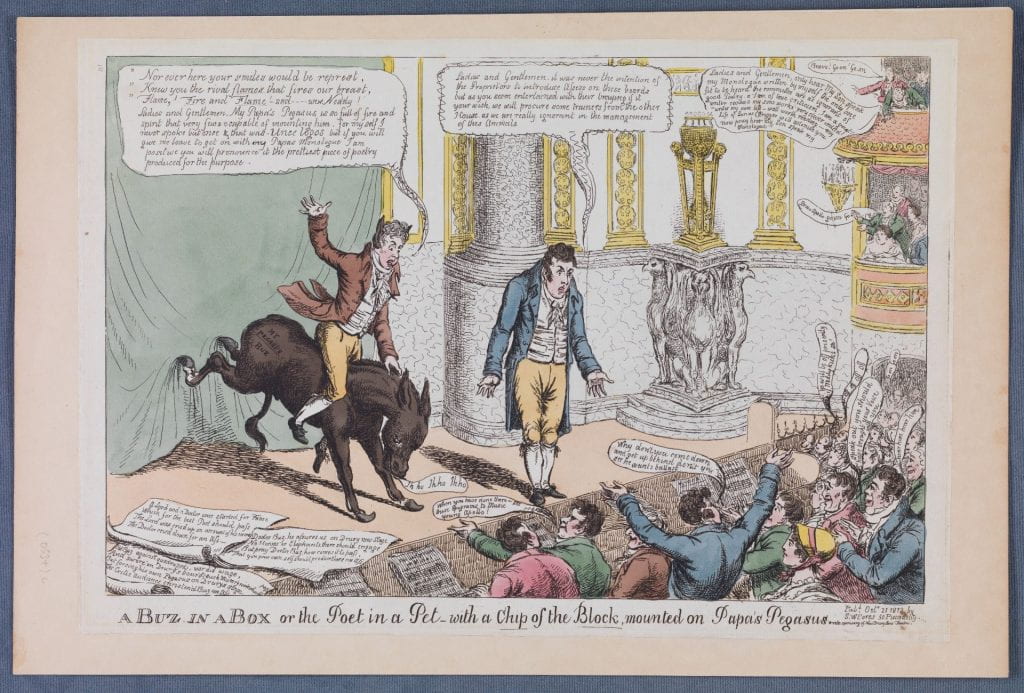
“A corner of the stage at Drury Lane slants diagonally from left to right, showing part of the orchestra and pit (right) with part of two stage-boxes on the extreme right. The stage manager, Raymond, stands addressing the clamorous audience, while on the left a young man with ass’s ears sits on a donkey which flourishes its heels so that they strike the lowered stage-curtain. The donkey brays “Ih ho Ih ho Ih ho,” its hind-quarter is branded ‘My Pegasus Buz’. Its rider recites: “Nor ever here your smiles would be represt, “Knew you the rival flames that fires our breast, “Flame, Fire and Flame!–sad–woe Neddy! Ladies and Gentlemen, My Papa’s Pegasus is so full of fire and spirit that very few are capable of mounting him. for my self I never spoke but once & that was– Unce logos but if you will give me leave to get on with my Papas Monologue I am positive you will pronounce it the prettiest piece of poetry produced for the purpose.” Raymond says: “Ladies and Gentlemen, it was never the intention of the Proprietors to introduce Assess [sic] on these boards but as you seem entertained with their braying if it [is] your wish, we will procure some trainers from the other House as we are really ignorant in the management of thes [sic] Animals.” Greeted by derisive cheers from the audience, Dr. Busby, also with ass’s ears, leans from the upper stage-box, saying, “Ladies and Gentlemen, only hear My Son speak my Monologue written by myself the only one fit to be heard the committee are as ignorant of good Poetry a[s] I am of true criticism. I am a great writer reviews my sons works very clever indeed–writes my own life–well worth reading–my Life of Lucius Otrigger will astonish you now pray hear my Son speak my Monologue!–.” A man behind him shouts: “Bravo! Go on! Go, on,” and one in the crowded lower box applauds: “Bravo Apollo go on Go . . .” In the foreground a man in the pit shouts pointing to the ass: “Why don’t you come down and get up behind don’t you see he wants ballast.” Six others address the son: “When you have done there–set those Epigrams to Music young Apollo!”; “Off Off Off Off”; “he will be off presently if Neddy kicks so!”; “Go on Go on”; “Speak out you should have brought your Voice with you”; “hear him hear him.” The orchestra is empty of performers, but the music scores are headed ‘The Judgement of Midas’ [O’Keefe’s play]. Three large papers lie on the stage inscribed respectively: [1] ‘A Lord [Byron] and a Doctor once started for Fame Which for the best Poet should pass The Lord was cried up on account of his name The Doctor cried down for an Ass–‘ [2] ‘Doctor Buz he assures us on Drury new Stage No Horses or Elephants, there should engage But pray Doctor Buz, how comes it to pass, That you your own self should produce there an Ass’ [3] ‘Old Buz against Quadrupeds, war did wage, And swore on Drury’s board’s such Mum’ry ne’er should pass But forcing his own Pegasus on Drurys stage The Critic Audience christen’d Buz an Ass.’ Behind Raymond is the lower part of the verd-antique pillar which flanked the curtain, and on the right the large ornate lamp, of quasi-Egyptian design in which three hawk-headed monsters support an inverted tripod, the base of a ring of lamp-jets.”–British Museum online catalogue.

  • Printmaker: Williams, Charles, active 1797-1830, printmaker.
  • Title: A buz in a box, or, The poet in a pet [graphic] : with a chip of the block, mounted on Papa’s Pegasus.
  • Publication: [London] : Pubd. Octr. 21, 1812, by S.W. Fores, 50 Piccadilly, [21 October 1812]

Catalog Record

812.10.21.01+

Acquired July 2023
Conjugal affection

description below

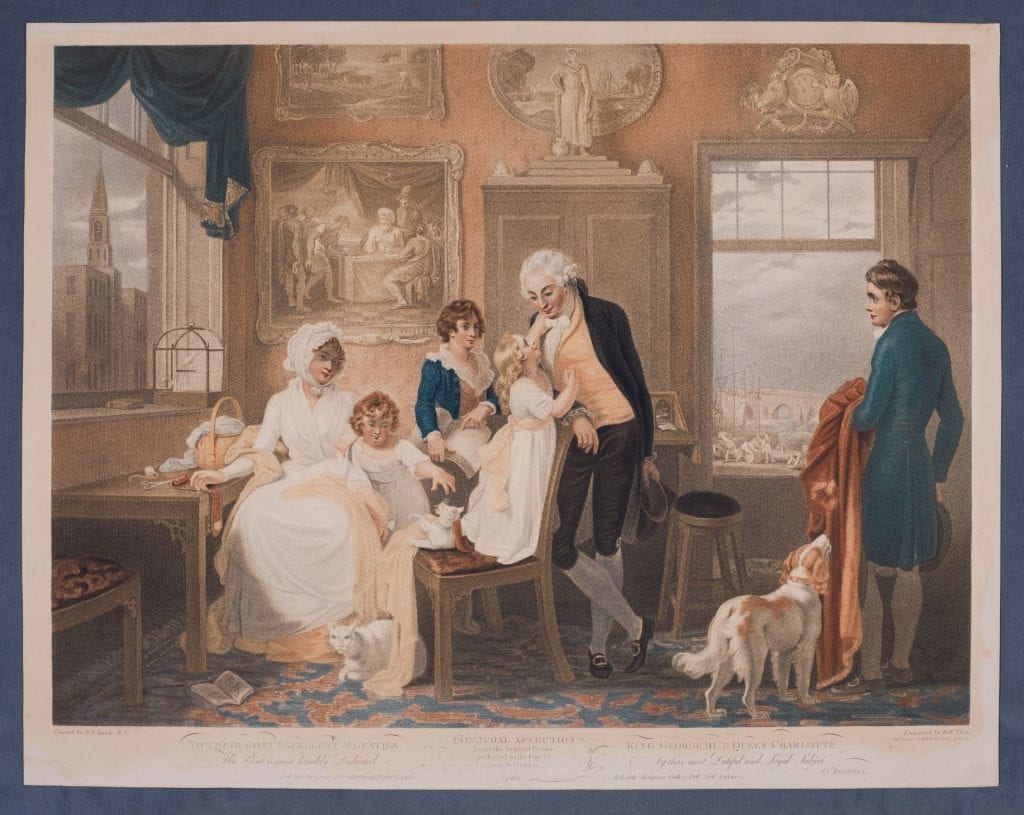
“A wealthy middle class family gathered in a room, the father standing in the centre, leaning on the back of a chair which his youngest child stands upon, embracing him, a son standing beside pointing to an open book and the mother sitting at left, gazing to right while another daughter beside plays with a kitten, a bird in a cage on table beside; at right an older son looks out anxiously at the ships on river beyond, his coat over his arm..”–British Museum online catalogue.

  • Printmaker: Thew, Robert, 1758-1802, printmaker.
  • Title: Conjugal affection [graphic] : from the original picture presented to the city by Aldn. Boydell / painted by Robt. Smirke R.A. ; engraved by Robt. Thew, Hist. Engraver to H.R.H the Prince of Wales.
  • Publication: [London] : Pub. Sept. 29, 1799, by J. & J. Boydell, No. 90 Cheapside, and at the Shakspeare Gallery, Pall Mall, London, [29 September 1799]

Catalog Record

799.09.29.01++

Acquired April 2023