Perspective view of the inside of the Royal Exchange in London

description below

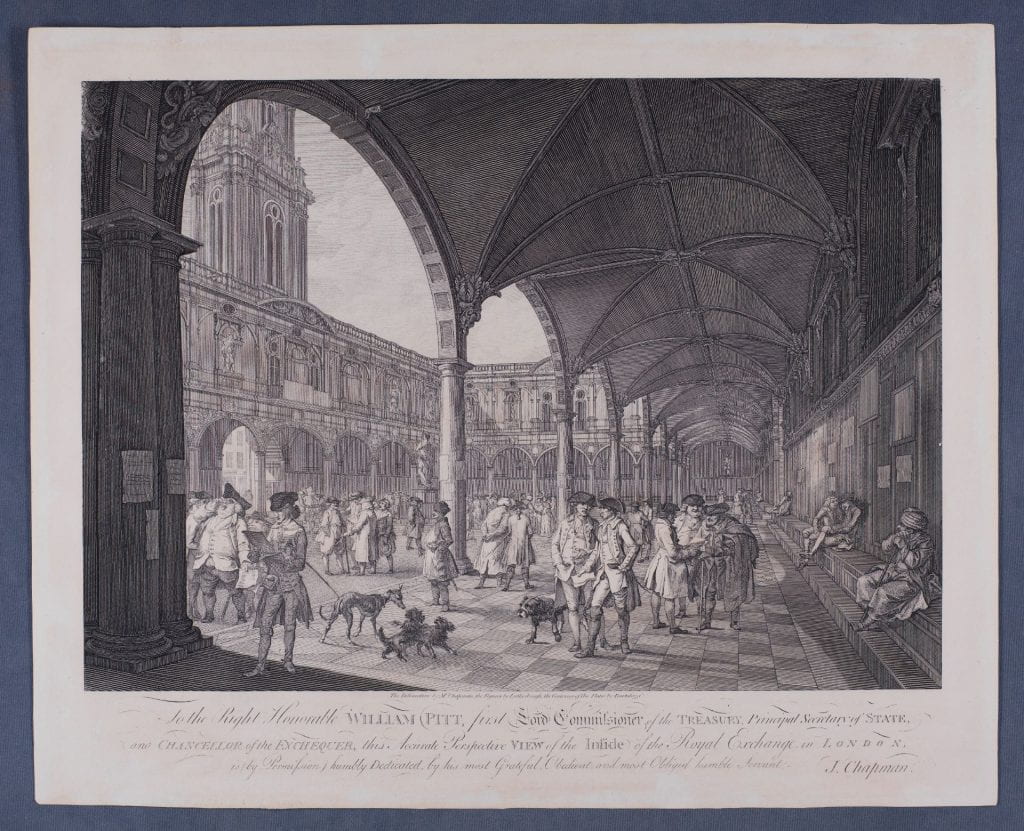
“Interior of the Royal Exchange; interior of the great quadrangle from the north-east corner of the inner cloister, or walk, with the clock tower on the left, and the court filled with merchants of various nations.”–British Museum online catalogue.

  • Printmaker: Bartolozzi, Francesco, 1727-1815, printmaker.
  • Title: To the Right Honorable William Pitt, first Lord Commissioner of the Treasury, Principal Secretary of State, and Chancellor of the Exchequer, this accurate perspective view of the inside of the Royal Exchange in London is (by permission) humbly dedicated by his most grateful, obedient, and most obliged humble servant, J. Chapman [graphic] / the delineation by Mr. Chapman, the figures by Lutherburgh, the graving of the plates by Bartolozzi.
  • Publication: [London] : [John Chapman], [1788]

Catalog Record

788.00.00.44++

Acquired April 2023

Volunteer infantry 1798

description below

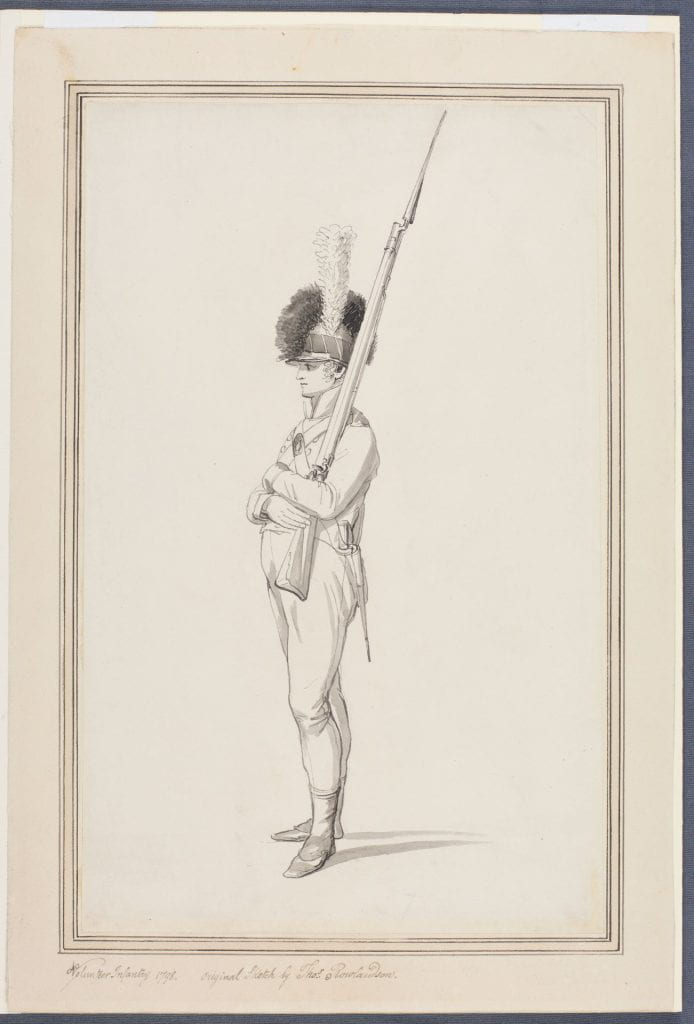
Full-length portrait of a soldier, in profile to the left, a rifle with bayonet resting against his left shoulder.


  • Creator: Rowlandson, Thomas, 1756-1827, artist.
  • Title: Volunteer infantry 1798 [art original] : original sketch by Thos. Rowlandson.
  • Production:[England], [1798]

Catalog Record

Drawings R79 no. 20 Box D207

Acquired November 2022

G. Wooll, carver & gilder, looking glass, picture frame maker

description below

A lithographically printed advertisement for G. Wooll of Hastings, showing a view of the town. Wooll was also a printer and publisher who issued local views of Hastings and Rye as individual prints and bound collections.


  • Printmaker: Tyller, G., printmaker.
  • Title: G. Wooll, carver & gilder, looking glass, picture frame maker, fancy stationer, printseller, &c. &c., High Street, Hastings [graphic] : Rich & plain cornices, chimney & pier glasses, box & swing ditto, gold bordering for rooms. Drawings lent to copy. Glasses polished & silvered. Old paintings cleaned and repaired. Drawing materials of every description. Screens, screen handles, embosed [sic] drawing boards, carde, papers & plain do. / drawn on stone by G. Tyller [or Tykes?], April 1823.
  • Publication: [London] : Printed by Simonau London, [1823]

Catalog Record

File 63 823 G1

Acquired January 2023

A full, true and correct statement ef [sic] the grand procdedings…

printed text

A broadside that lays out Queen Caroline’s appeal to be rightfully crowned Queen alongside her estranged husband George IV. Despite the withdrawal of the Pains and Penalties Bill following Caroline’s trial in the House of Lords, the King continued to shun his wife, culminating in his refusal to allow her entry into the coronation which took place at Westminster Abbey on July 19th, 1821.

  • Title: A full, true and correct statement ef [sic] the grand procdedings [sic] [that] took place on Thursday, 19th of July, in the city of London, on the coronation of His Royal Majesty King George the Fourth : giving an account of the protestation of Her Most Grrcious [sic] and Royal Majesty Caroline Queens [sic] of England, against the decision of the Privy Connsil [sic].
  • Publication: [Cork, Ireland] : Henry Baird, printer, No. 21, Paul-Street, Cork, [1821]

Catalog Record

File 53 C292 821Fu

Acquired August 2022

A new Chancery suit removed to the Scotch bar

description below

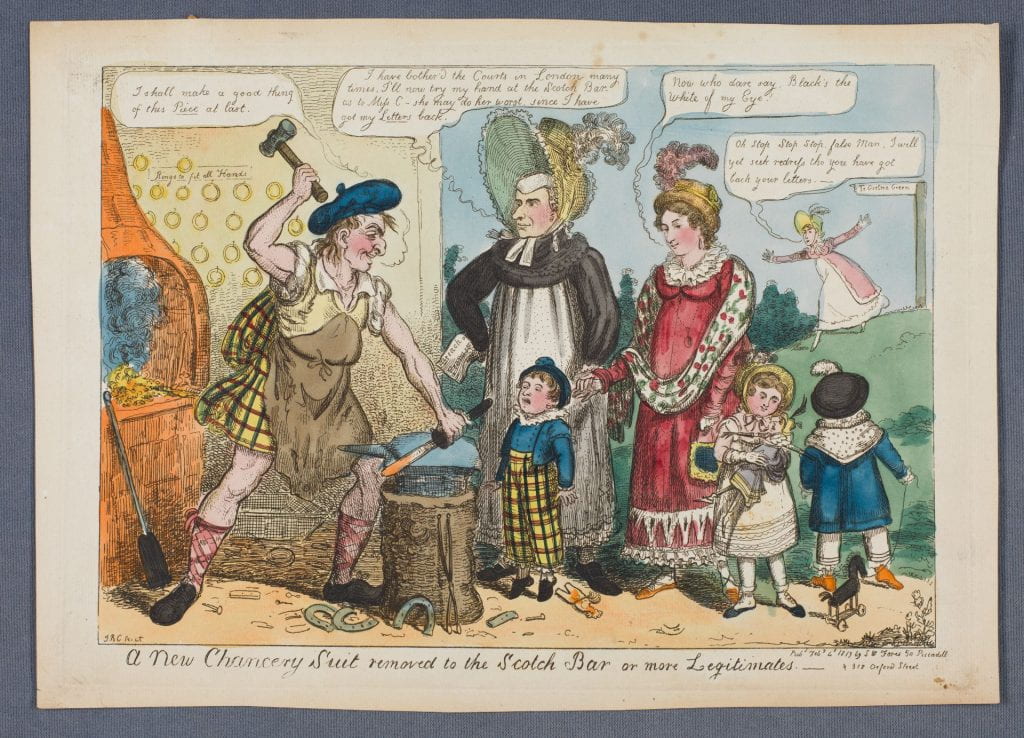
Print shows a Gretna Green marriage in an open-fronted smithy. Erskine, disguised in woman’s dress with a huge feathered bonnet over a barrister’s wig, holds the right hand of a demure-looking woman, modishly dressed and apparently pregnant. He holds a paper: ‘Breach of Promise’. With them are three young children. The smith wears Highland dress; he holds a red-hot bar on the anvil and raises his hammer, saying, “I shall make a good thing of this Piece at last.” Erskine says: “I have bother’d the Courts in London many times, I’ll now try my hand at the Scotch Bar–as to Miss C– she may do her worst since I have got my Letters back.” The woman says: “Now who dare say, Blacks the White of my Eye.” In the background (right) a young woman rushes down a slope towards the smithy, shouting, “Oh Stop Stop Stop, false Man, I will yet seek redress tho you have got back your letters–” Beside her is a sign-post pointing ‘To Gretna Green’. A little boy with Erskine’s features, wearing tartan trousers, stands on tip-toe to watch the smith; on the ground beside him is a toy (or emblem), a cock on a pair of breeches. A little girl stands by her mother nursing a doll fashionably dressed as a woman, but with Erskine’s profile. Another boy with a toy horse on a string stands in back view watching ‘Miss C’. Behind the smith is the furnace; on the wall hang many rings: ‘Rings to fit all Hands.’


  • Printmaker: Cruikshank, Robert, 1789-1856, printmaker.
  • Title: A new Chancery suit removed to the Scotch bar, or, More legitimates [graphic] / I.R.C. fecit.
  • Publication: [London] : Pubd. Feby. 4th, 1819, by S.W. Fores, 50 Piccadilly & 312 Oxford Street, [4 February 1819]

Catalog record

819.02.04.01+

Acquired November 2022

Le colera de Napoleon

description below

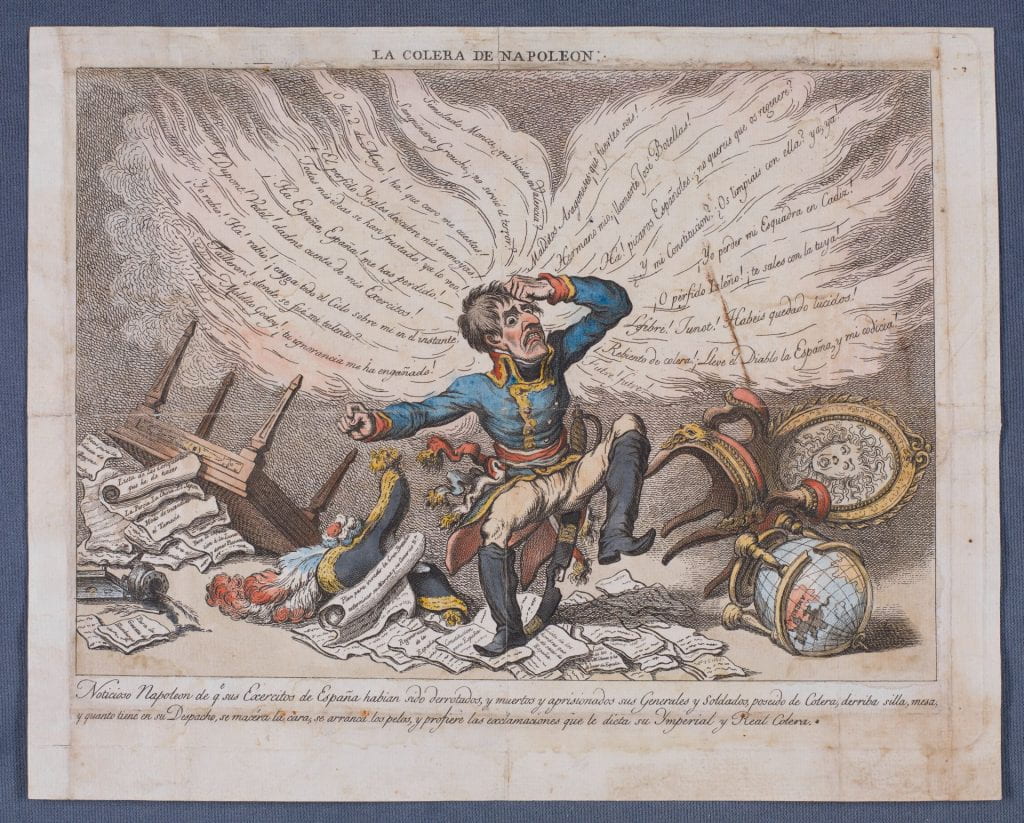
A Spanish version of Gillray’s 1803 satire ‘Maniac Raving’s-or-Little Boney in a Strong Fit’, the texts in the plate adapted to the Spanish relationship with France during the Peninsular War – after the invading French armies were defeated by the Spanish in Andalusia at the Battle of Bailen ‘Napoleon is frantic with rage at the news from Spain… He blames Godoy (whom he had made ‘Prince of the Algarves’) for deceiving him, apostrophizes Talleyrand, reproaches Dupont, and his second-in-command Vedel, for the capitulation of Baylen… his deceptions are discovered by the ‘perfidious Englishman’, probably Sir Hew Dalrymple, the Governor of Gibraltar’ (British Museum catalogue).

  • Title: Le colera de Napoleon [graphic].
  • Publication: [Spain] : [publisher not identified], [1808 or 1809?]

Catalog Record

808.00.00.38+

Acquired April 2023

After the invasion

description below

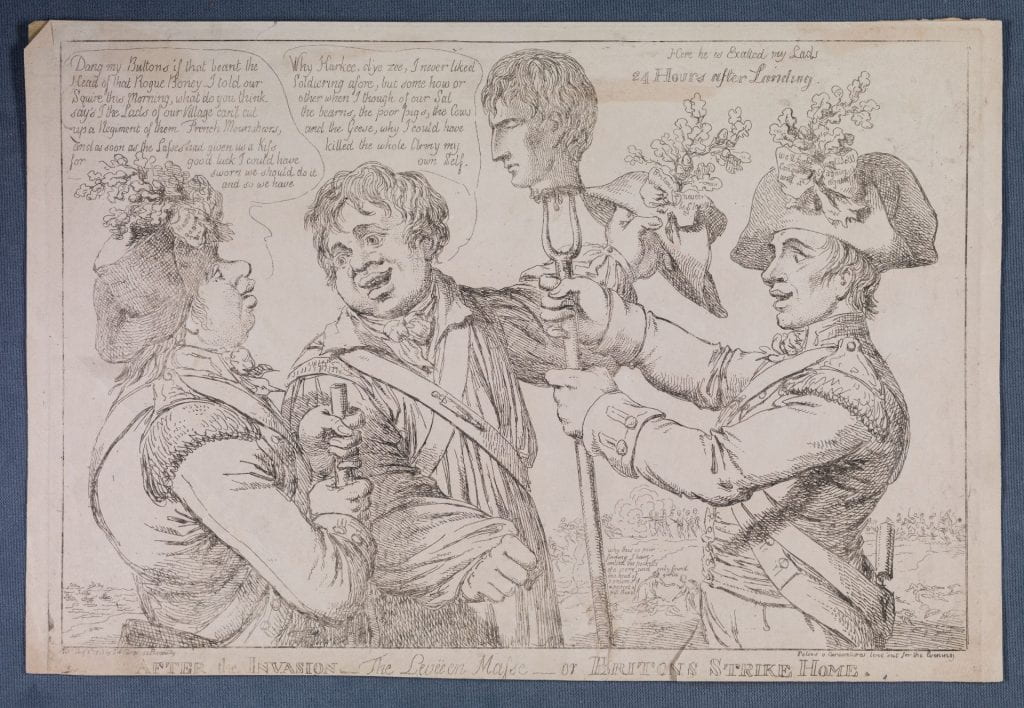
“Three volunteers or militiamen, three-quarter length figures, exult at the head of Bonaparte which one of them (right) holds up on a pitchfork, saying, “Here he is Exalted my Lads 24 Hours after Landing.” The head is in profile to the left, the sharp well-cut features contrast with those of the chubby yokels. The centre figure, holding out his hat, says, turning to the left: “Why Harkee, d’ye zee, I never liked Soldiering afore, but some how or other when I though [sic] of our Sal the bearns, the poor pigs, the Cows and the Geese, why I could have killed the whole Army my own Self.” He wears a smock with the crossed straps of a cartouche-box. The third man (left) in regimentals, but round-shouldered and unsoldierly, says: “Dang my Buttons if that beant the Head of that Rogue Boney – I told our Squire this Morning, what do you think say’s I the Lads of our Village can’t cut up a Regiment of them French Mounsheers, and as soon as the Lasses had given us a Kiss for good luck I could have sworn we should do it and so we have.” All three have hats turned up with favours and oak-twigs, the favours being inscribed respectively (left to right): ‘Hearts of Oak’; ‘Britons never will be Slaves’, and ‘We’ll fight and We’ll Conquer again and again’. In the spaces between these foreground figures is seen a distant encounter between English horse and foot and French invaders, who are being driven into the sea, on which are flat-bottomed boats, all on a very small scale. Two women search French corpses; one says: “why this is poor finding I have emtied the pocketts of a score and only found one head of garlic 9 onions & a parcel of pill Boxes.” Cf. British Museum Satires No. 8145.”–British Museum online catalogue.

  • Printmaker: Williams, Charles, active 1797-1830, printmaker.
  • Title: After the invasion [graphic] : the levée en masse, or, Britons strike home.
  • Publication: [London] : Pub. Augt. 6th, 1803, by S.W. Fores, 50 Piccadilly, [6 August 1803]

Catalog Record

802.08.06.01+

Acquired April 2023
The march of interlect

description below

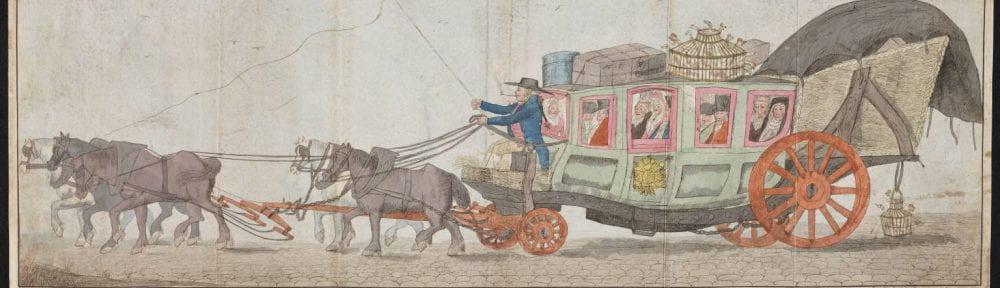
“Caricature with a family of a working man, his wife and daughter dressed in fashionable clothes, with a cottage and pig on a dung-hill in the background.”–British Museum online catalogue.
A satire on the aspirations of the working classes. The affluently dressed dustman’s wife asks her husband if he has seen the latest issue of ‘La Bells Ass-emblee’ (John Bell’s La Belle Assemblée, or Bell’s Court and Fashionable Magazine).


  • Printmaker: Marks, John Lewis, printmaker.
  • Title: The march of interlect, or, A dust-man & family of the 19th century [graphic] / Marks fect.
  • Publication: London : Published by J.L. Marks, 17 Artillery St., Bishopsgate, [approximately 1824]

Catalog Record

824.00.00.64

Acquired November 2022

Reginald Heber book of poems and drawings

manuscript journal

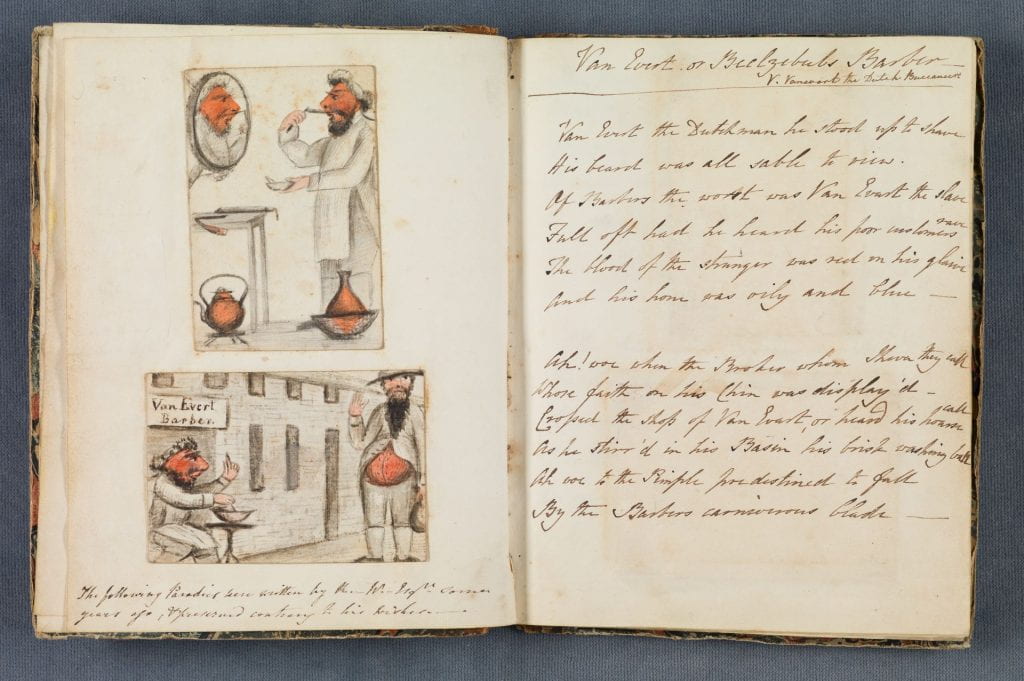
A volume of comical poems and a play, “Blue Beard”, with 22 transformation cards that illustrate the themes with humorous images of characters performing various activities. Several depict barbers and their customers or other people in the act of grooming and taking medicines, which accompany “Van Evert the or Beelzebubs Barber, V. Vanevert the Dutch Buccaneer”. The poem “The Silver Ladle” is illustrated with a card with two women in a kitchen with a tea kettle. “Bill Bolton, the weaver”, a Scottish tale, illustrated with a pen and ink drawing of a funeral procession


  • Author: Heber, Reginald, 1783-1826.
  • Title: Reginald Heber book of poems and drawings : manuscript.
  • Production: England, circa 1815.

Catalog Record

LWL Mss Vol. 280

Acquired August 2022