“What ever is, is right. Pope!

description below

“A scene in the House of Commons, showing the Ministerial benches, with the Speaker’s Chair and the Table partly cut off by the right margin. The Speaker (Manners Sutton) and one of the Clerks are just within the design. Castlereagh is speaking; he stands in profile to the right, hat in hand, with the Pope on his shoulders. The Pope holds crosier and keys, and wears an odd tiara. A demon crouches on his shoulders dressed as an acolyte, but displaying a cloven hoof; a mask with bland features (a device deriving from Gillray, cf. British Museum Satires No. 11384) is tied in front of his black horned head; he holds up a lighted candle, and clutches the Pope’s hair. Castlereagh, with a blandly disingenuous smile: “I have the authority of the Head of the Catholic Church, for saying that there is no solidity in the objection taken on the other side: thus I am legislating with the Pope at my back!!!” The benches behind Castlereagh are crowded; the members listening intently; all wear hats, except Peel who sits immediately behind Castlereagh’s empty seat, on the corner of which he has put a hat, inscribed ‘Peel’. He looks up to say: “I hope that when the noble Lord observed that [he was legislating with the Pope at his back] he had no allusion to me, even if the noble Lord were willing to put the Popedom in Commission, I should not be willing to accept the office of one of the Commissioners.” Men look down from the gallery. On the floor is a paper: ‘St Steevens March 28 1821’.”–British Museum online catalogue

  • Title: “What ever is, is right. Pope! A weighty argument in favour of the Catholic Emancipation 
  • Creator: Cruikshank, Robert, 1789-1856, printmaker
  • Published: London, April 1821

Catalog Record

821.04.00.03+

Acquired October 2024
Transubstantiation, or, Symptoms of dictating, cabaling, conspiring, overawing…

description below

“The King (left), plainly dressed, sits on a chair on a dais, a pillar and curtain indicating the throne. He angrily addresses a band of Ministers (and others) who are encircled by a ribbon inscribed The Bond of Union; the end of this is held by the Pope (right). Raising a document inscribed Coronation Oath he exclaims: Is that your only Bond of Union? Is that the flimsey Thread that Ties this hetrogenous [sic] Mass. What? have ye hid your base designs beneath the Cloak of Secrecy? Think ye to Catch your Sovereign off his guard? to tempt him to forget his Solemn Oath? and by one desperate Stroke, destroy the Church & Constitution too?!! begone, and instantly give place to honest Men. Lady Conyngham peeps from behind his chair, saying, I do exceedingly Fear & Tremble. The nine Ministers, closely tied together, advance menacingly, each raising a cross in the right hand. The Pope, triumphant and sinister, also holding a cross, says: Strike My Son’s Now or never!! The four nearest the picture plane are (left to right) Canning, Brougham, Burdett, and Lansdowne with Scarlett just behind him; the other four are partly hidden and poorly characterized. Lansdowne is copied from satires of 1806-7, when he was Chancellor of the Exchequer: he is dwarfish, and held up by the ‘Bond’, his legs dangling. Three say respectively: No bolting when you come to the Scratch; Nine to one will certainly be more–than a Match for him; Stick together. Above them flies a demon holding the firebrand of Discord, while Harmony, a winged child (right) holding a lyre, flies off discomfited.”–British Museum online catalogue

  • Title: Transubstantiation, or, Symptoms of dictating, cabaling, conspiring, overawing &c. &c. [graphic]
  • Creator: Heath, Henry, active 1824-1850, printmaker
  • Published: London, [16 May 1827]

Catalog Record

827.05.16.01+

Acquired June 2024

Chairing the jolly god, or, A Southampton election in the modern times of 1830

description below

Satire on the Southampton parliamentary election of 1830. A large parade of people, including ‘Tradesmen on the Grand Committee,’ ‘Inferior Tradesmen on the Kingland & Cossac Committee,’ ‘Publicans,’ ‘Brewers,’ ‘Itchen Ferrymen,’ ‘Fishwomen,’ and ‘Blidgeon Men employed from the Forest,’ all march, holding flags above their hats. In the center on being carried in a grand chair, appears to be James Barlow Hoy (1794-1843), Irish-born military surgeon and politician who represented the Southampton constituency in the British parliament and also served as Deputy Lieutenant Sheriff of Southampton. The print appears to also refer to the corruptness of the Southampton parliamentary election of 1830; John Story Penleaze stood as a candidate but resigned before the end of the poll. He had been proposed by William Lankester, an upholsterer and prominent radical, who headed a newly formed ‘Independent Committee’, and seconded by Bryant. Although Hoy was proposed by Rose, he affirmed his commitment to the independent political line he had hitherto pursued, for which even Stanton gave him credit, and cited his endeavours to obtain improved status for Southampton as a port. The Members were returned unopposed and chaired without incident.

  • Title: Chairing the jolly god, or, A Southampton election in the modern times of 1830
  • Creator: Skelton, Thomas Henry, active 1830-1844, publisher
  • Publication: Southampton, England, approximately 1830

Catalog Record

830.00.00.171+

Acquired June 2024

Journeymen hatters dipping their master in the dye

description below

Four employees of a hatter force their employer into a bath of black dye. One of the journeymen holds a beaver by its tail as it cries “He robbed me of my coat, and blam’d others for it.” A young apprentice entering from the right holds out a fish to the beaver. In the foreground a black demon whose speech balloon reads, “Push him through my lads. I’ll adopt him as one of my children.”

  • Printmaker: Charles, William, 1776-1820, printmaker, artist.
  • Title: Journeymen hatters dipping their master in the dye [graphic] / Charles del. et sculp.
  • Publication: [London?] : [publisher not identified], publishd. April 14th, 1806.

Catalog Record

806.04.14.01+

Acquired April 2024

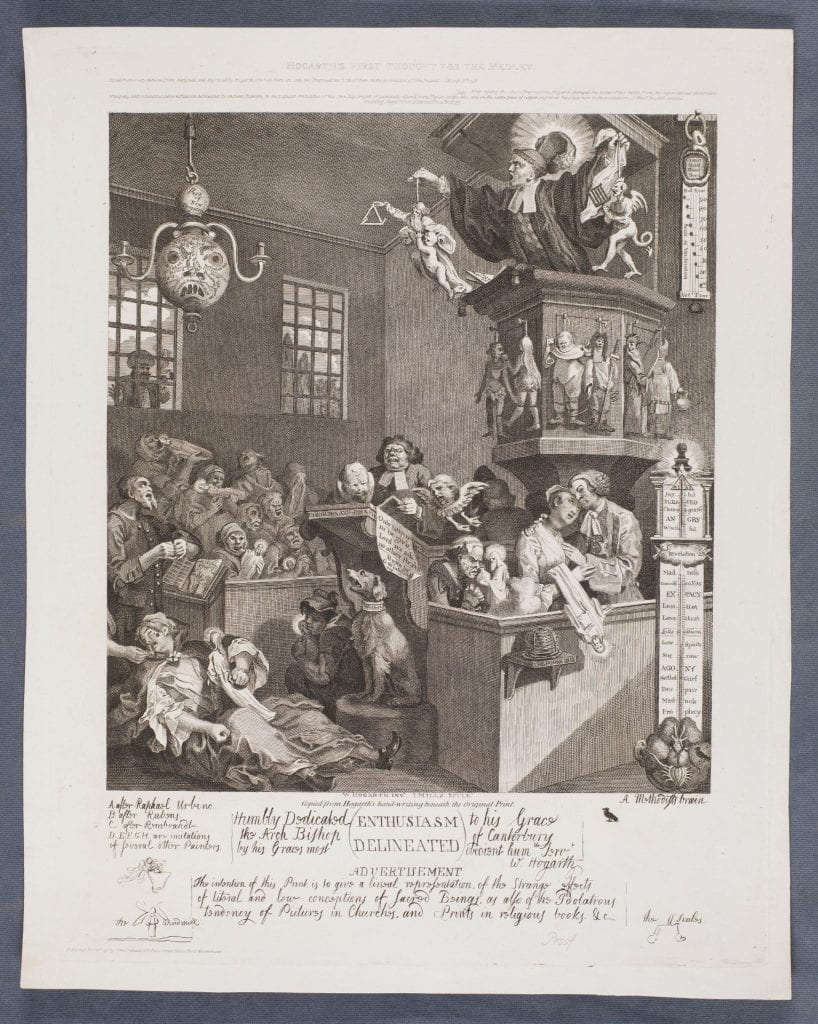
Enthusiasm delineated

description below

Copy of Hogarth’s print; interior of a chapel with an impassioned preacher inspiring his listeners who include a woman swooning on the floor and a young couple embracing; many of the congregation are clutching figures of Christ; a barking dog with a collar labelled “Whitfield” echoes the preacher. In the lower rigth corner, an image of a cross-section of brain, labeled below frame “A Methodist’s brain”

  • Printmaker: Mills, Isaac, 1770-1857, printmaker.
  • Title: Enthusiasm delineated [graphic] / W. Hogarth invt. ; I. Mills sculpt. ; copied from Hogarth’s hand-writing beneath the original print.
  • Edition: Proof.
  • Publication: [London] : Published Novr. 12th, 1795 by John Ireland, No. 3 Poets Corner, Palace Yard, Wesminster, [12 November 1795]

Catalog Record

795.11.12.02+

Acquired September 2022

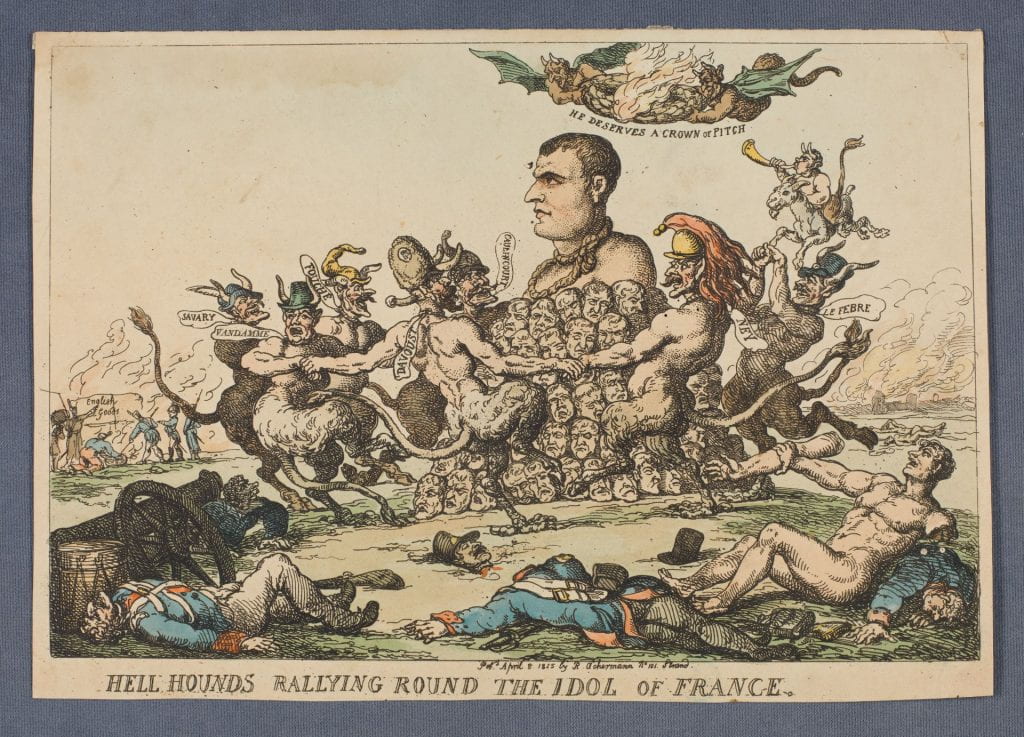
Hell hounds rallying round the idol of France

description below

“A colossal but life-like bust of Napoleon is placed on a mound of decollated human heads. He gazes fixedly upwards in profile to the left; round his neck and bare breast is twisted a noose of rope. Round this idol dance demons with human heads, holding hands. They are naked except for head-coverings, and have horns, hairy legs, tail, with one leg terminating in a cloven hoof, the other in the claw of a bird of prey. These ‘Hell Hounds’ have labels hanging from a collar of rope, showing that they are ‘Caulincourt’, ‘Fouché’, ‘Savory’, with a pen in his hat (he succeeded Fouché as Minister of Police in 1810), ‘Vandamme’, ‘Davoust’, ‘Ney’, ‘Lefebre’. Two demons fly towards the emperor, holding a large wreath which is on fire, with the inscription ‘He Deserves A Crown of Pitch.’ This they are about to place on the idol’s head, towards which gallops through the air a small demon (right) on a goat, blowing a horn. In the foreground lie dead and dying soldiers, one is decapitated, another (right) is naked and has lost an arm which he holds out with an agonized expression towards the idol. In the background (left) soldiers are feeding a bonfire with ‘English Goods’. On the right is a blazing town.”–British Museum online catalogue.


  • Printmaker: Rowlandson, Thomas, 1756-1827, printmaker.
  • Title: Hell hounds rallying round the idol of France [graphic].
  • Publication: [London] : Pubd. April 8, 1815, by R. Ackermann, No. 101 Strand, [8 April 1815]

Catalog record

815.04.08.01+

Acquired November 2022

A representation of the present state of France

description below

“Napoleon, pushing an officer before him through a pillared doorway, looks back to speak to a monk and a sansculotte, shackled together, who drag a car in which is an imperial crown. They hold a large scroll inscribed: ‘Most religious Sovereign – the benefactor of the church – the patron of liberty – the scourge of tyrants, and the defender of our most holy religion; may you long fill the Imperial Chair, and diffuse over a free and happy people all the blessings of your auspicious government.’ Demons fly round a tricolour flag which floats from the car. Napoleon holds out a scroll headed: ‘Address, &c. &c. &c. The Legions of France congratu – ‘, saying, “This token of your gratitude, my dear subjects will ever stimulate me to protect your liberties – to promote your happiness – and to preserve my empire from the ravages of war, tyranny and oppression.” The officer, with a cynical smile, says: “Patron of Liberty – Defender of our most holy Religion – free and happy People – Ha! ha! ha! – What may we not expect? – Has he not got them under excellent subjection?” On the left is Napoleon’s ‘Secret Chamber’: a table is covered with maps and plans; a large map, partly unrolled, shows Europe from ‘[En]gland to [Tur]key’, including the ‘Black Sea’; another map shows ‘Suez’ and the ‘Red Sea’. A demon under the table holds up a large pile of papers: ‘Plans against England’; on the floor are similar piles: ‘Religion’ and ‘Treaties’. There are also ‘Plans against Germany and Turkey’, and a paper: ‘Mem. the chance of the conquest of England is worth the sacrifice of one third of the people of France. Item. As Charlemaine not only conquered Italy, but the whole of Germany, and left the Imperial dignity hereditary in the Sovereigns of France, it is indispensably necessary to obtain possession of Germany, in order to support the dignity of the Gallic empire.’ On the wall are three pictures: ‘Sacking of Rome’, ‘Dissolution of the National Assembly’ [see British Museum Satires No. 9426, &c], and ‘View of Cairo’ [see British Museum Satires No. 9358, &c.]. Below the design: ‘Explanation. The two figures bringing the Imperial crown . . . represent . . . the bitter Enemies of Aristocracy, and the staunch Supporters of the late Monarchial Government, tackled to the National Machine, and reduced to the most abject State of Slavery by the Influence of the Military, whose congratulatory Address Bonaparte has received at the Hand of an Officer, and is introducing him into his Secret Chamber to receive Instructions. The Demons hovering over the Imperial Crown denote Five Years of Destruction; during which Period Bonaparte will overrun and ravage the greater Part of the Continent of Europe, be the Means of nearly depopulating Turkey, and finally be slain with the Sword, be cast out as an abominable Branch, and be left as Dung to rot on the Face of the Earth.”–British Museum online catalogue.

  • Title: A representation of the present state of France [graphic].
  • Publication:[London] : Published by L. Mayer, as the act directs, August 13, 1804.
  • Manufacture: [London] : Bryer, printer, Bridge Street, Blackfriars

Catalog Record

804.08.13.01+

Acquired May 2021


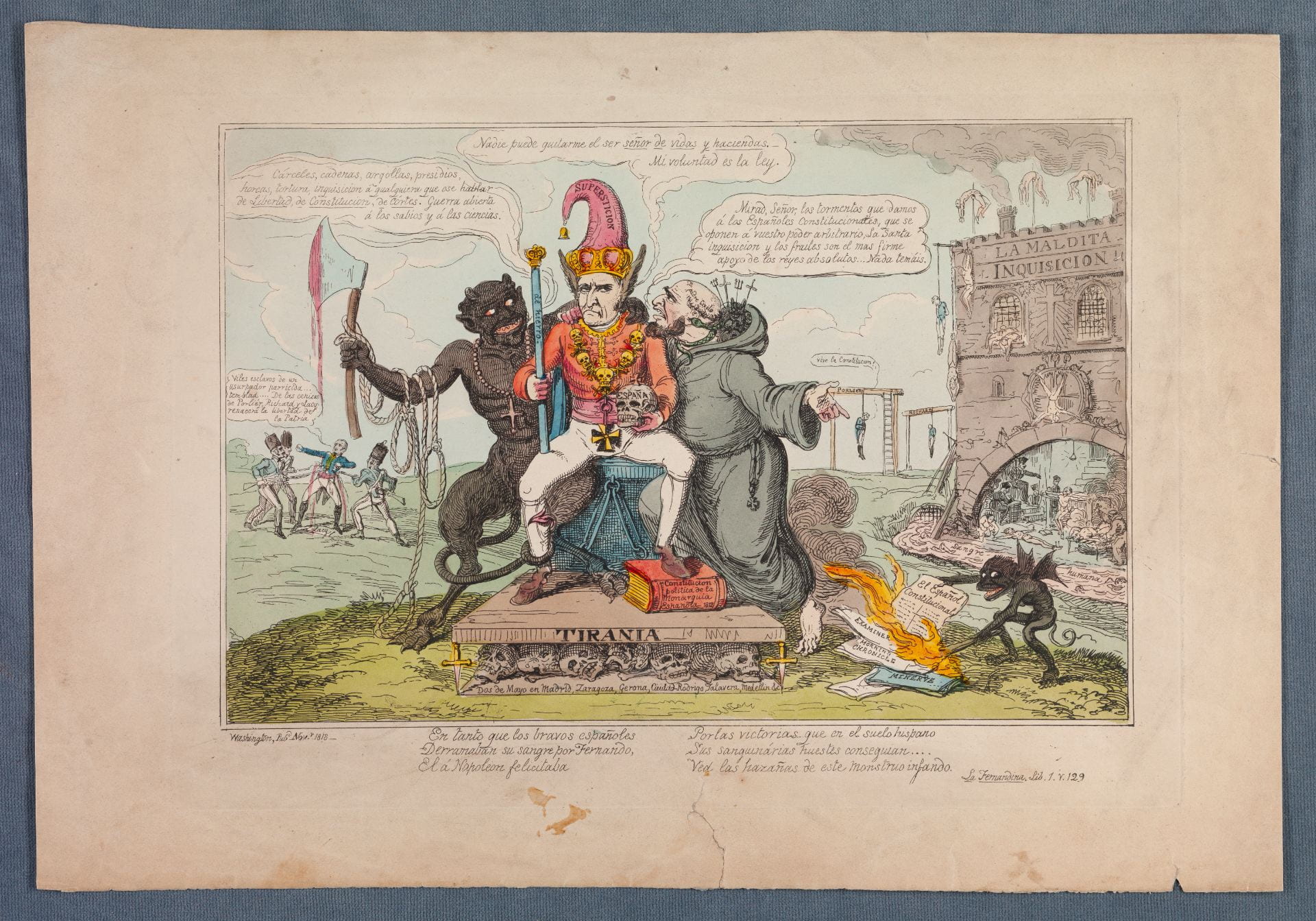
Tirania

description below

Ferdinand VII, seated on a throne on a low platform inscribed “TIRANIA”, is flanked by two advisers, the Devil on the left and a friar on the right. At the friar’s feet, in the foreground, a demon burns newspapers with a firebrand. Tortures of the Inquisition are seen in the background.

  • Title: Tirania [graphic].
  • Publication: [London?] : Washington, pubd. Novr. 1818.

Catalog Record

818.11.00.01+

Acquired March 2020

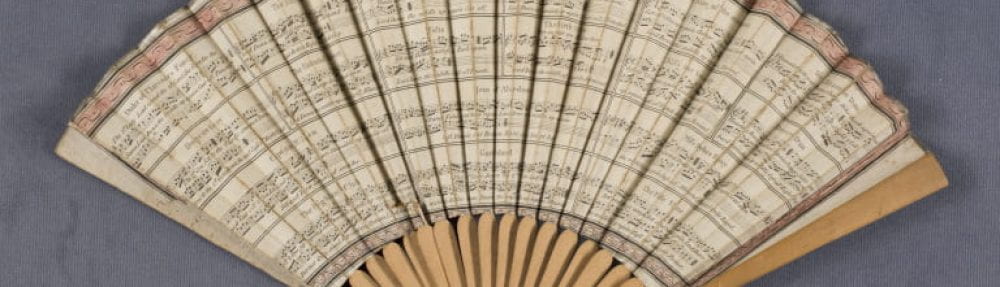
The six ologies

description below

description below

  • Printmaker: Stanley, Edward, 1779-1849, printmaker.
  • Title: The six ologies : viz. entomology, anthology, demonology, ornithology, craniology, apology.
  • Publication: [England] : [publisher not identified], [ca. 1825]

Catalog Record

Folio 75 St787 825

Acquired November 2020

The man wots got the whip hand of ’em all

The man wots got the whip hand of 'em all. Detailed description below

“A hand printing-press of metal (a Stanhope Press), supported on the stout legs of a man in breeches which seem to belong to a John Bull, puts to flight mere pigmy humans: two flee to the right, one propelled by a kick from a huge buckled shoe; two others have fallen. Two levers or handles serve as arms; one has a hand which grasps a giant pen, the feather entwined with three serpents which spit flame at the departing legs and cocked hat of Wellington, who, kicked into the air, disappears behind the upper right margin of the design. Another pair of legs, with the black stockings and buckled shoes of Eldon, project from the upper left margin; beside them a single leg and a broom indicate the departing Brougham. A second lever supports a print, ‘The Man Wot Drives The Sovereign’, copied from British Museum satires no. 15731; a flame issues from the press, threatening to scorch or destroy the print. The press is topped by a cap of Liberty inscribed ‘Free Press’ and encircled with a wreath. A little demon (a printer’s devil) rushes towards the press from the left, holding up a big ink-ball.”–British Museum online catalogue.

  • Printmaker: Heath, William, 1795-1840, printmaker.
  • Title: The man wots got the whip hand of ’em all [graphic].
  • Publication: [London] : Pub. May 30th, 1829, by T. McLean, 26 Haymarket …, [30 May 1829]

Catalog Record 

829.05.30.01+

Acquired October 2018