Party Diplomacy: The Ravi D. Goel Collection on Henry Roe Cloud

Thanks to the generosity of donor Ravi D. Goel (Yale College, 1993), Manuscripts and Archives has received a collection created by Henry Roe Cloud, the first self-identified Native American to graduate Yale University.

Henry Roe Cloud was born on a Winnebago reservation in Nebraska in the mid-1880s. Like many Native American children born on reservations in that time period, Cloud went to an Indian school to learn how to read and write in English as well as a trade. Cloud was an exceptional student, moving on to a private boarding school in Massachusetts before starting Yale College in 1906. While at Yale, he was adopted by the Roe family, missionaries that spent some of their time preaching among Native Americans. He received his bachelors in psychology and philosophy in 1910 and his masters in anthropology in 1914. He became a Presbyterian minister, an official within the Office of Indian Affairs, and a lifelong advocate of modern education for Native American youth.

Manuscripts and Archives already holds a collection with some of Cloud’s letters in the Roe Family Papers (MS 774). However, with this new collection, we received more correspondence, including a set of letters addressed to Cloud’s daughter, Marion Roe Cloud Hughes.

The letters were written when Cloud was traveling on behalf of the Office of Indian Affairs. One letter in particular stood out to me because of its familiarity of situation to most: being stuck at a fancy party, unsure what to do.

That’s not to say that Cloud was particularly shy. At Yale he was part of a fraternity (Beta Theta Pi), the debate club, and the Elihu Club. He also regularly talked to people in the course of his work. However, it must have been daunting to be invited to tea with the ambassador to the United States at the Chinese embassy. While Cloud and the ambassador were classmates at Yale together, this was still a far more formal event than Cloud was used to.

Getting to the tea was the first difficulty as neither Cloud nor the taxi driver had change for Cloud’s five dollar bill. Cloud wound up having to ask around the embassy for change before giving the driver $3.00 for a 50 cent fare. When he finally entered the embassy and was received by the ambassador and one of his daughters, Cloud was not quite pleased when the ambassador commented on “how stout” Cloud was and asking what Cloud ate. Embarrassed, Cloud found himself moving on and then lost amongst the 400 or so guests.

Cloud did find a solution to feeling lost. He took refuge at a nearby table with cocktails. After imbibing a bit, he then found his courage to try to find the Chinese ambassador’s other daughters. His purpose, he explained to Marion, was to show the ambassador’s daughters a picture of her and her three sisters so as to have occasion to speak with them further:

“I even went so far as to vie with other ambassadors for the Central and South America republics by saying I was representing the North American Indians! At this the Embassy cohorts lifted eyebrows as much as to convey the thought to me—‘Yes, I duly feel your importance.’ To one I said, ‘I am anxious to meet the other daughters of the Ambassador’…Soon I was face to face with the daughter and I pulled out your picture with your sisters.”

The daughter wrote her sisters’ names on the envelope of the picture for Marion and her sisters at Cloud’s request, but otherwise did not seem interested in Cloud’s photograph. Thankfully, he discovered food nearby and wound up in the company of another Chinese citizen who split a taxi with him home from the tea—Cloud would have walked home otherwise, “even if it took me till midnight.”

While the party probably didn’t go as Cloud would have liked, at least he had an adventure to relate to Marion. We now also have the letter so we can share in it as well.

The first page of Henry Roe Cloud's letter to his daughter Marion.

The first page of Henry Roe Cloud’s letter to his daughter Marion.

Researchers interested in seeing the Ravi D. Goel Collection on Henry Roe Cloud (MS 2008) can now do so via the finding aid located here. To learn more about using Manuscripts and Archives collections, you can visit our website here.

Coalition for People and the West Rock Youth Leadership Program

Manuscripts and Archives recently completed work on a collection of records created by the Greater New Haven Coalition for People (MS 2007). The Greater New Haven Coalition for People was founded in 1981 as an umbrella group of different community agencies and organizations that were concerned about the effect of budget cuts on programs here in the city of New Haven, Connecticut. Soon it evolved into a grassroots organization that focused on organizing and addressing a variety of issues that impacted the low and middle income residents of the city. Some important issues to the group include conditions and safety of public housing, health care and low-cost prescription medication availability for low-income patients, especially those who are uninsured, public transit safety and availability, and programs for children and adolescents.

In 1994, Coalition for People focused heavily on the last item. As they often did fundraising and work with other community organizations, they were included in a Request for Proposals for advanced youth leadership training programs by the Community Foundation for Greater New Haven. The Community Foundation had been developing these programs with groups like the Coalition for People for the past two years and wished to provide funding and direction for another year. The focus of the 1994 programs was on younger adolescents in the Fair Haven and West Rock neighborhoods. The core curriculum was focused on such things as “Communication (Individual/Group), Planning and Problem Solving, Cognitive/Academic Support, Conflict Resolution/Mediation, and Diversity/Cultural Awareness.” Other aspects of the program included placing participants with mentors, a neighborhood event planned by the participants and special recreation trips.

The Community Foundation for Greater New Haven specifically named Coalition for People to lead the program for the West Rock neighborhood. Coalition for People devised a complete program that was approved and put into action in the summer of 1994. This program was called the West Rock Youth Leadership Program.

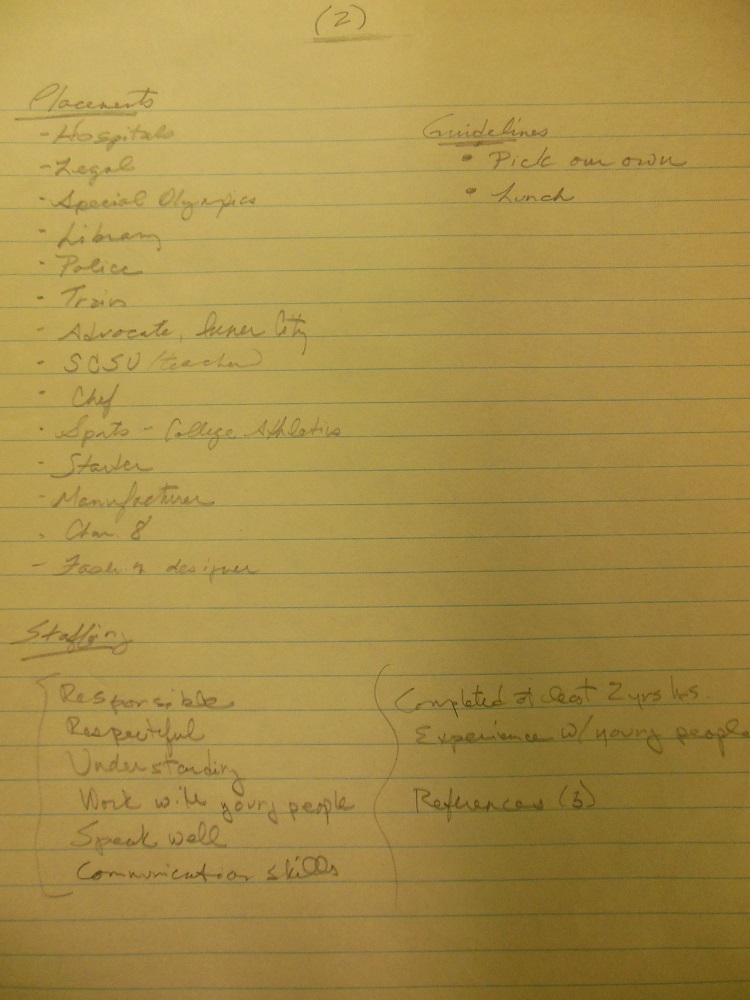
In this document from a March 16th meeting, you can see the Coalition brainstorming many aspects of the Leadership Program, including possible community events, recreation, placements for participants, and what they expected from the staff they hired for the program.

Planning for the West Rock Youth Leadership Program.

From MS 2007, Box 19, Folder 10.

Planning for the West Rock Youth Leadership Program.

From MS 2007, Box 19, Folder 10.

This draft of the program’s schedule gives you an idea of what they were planning for the adolescents.

Proposed schedule for the West Rock Youth Leadership Program.

From MS 2007, Box 19, Folder 3.

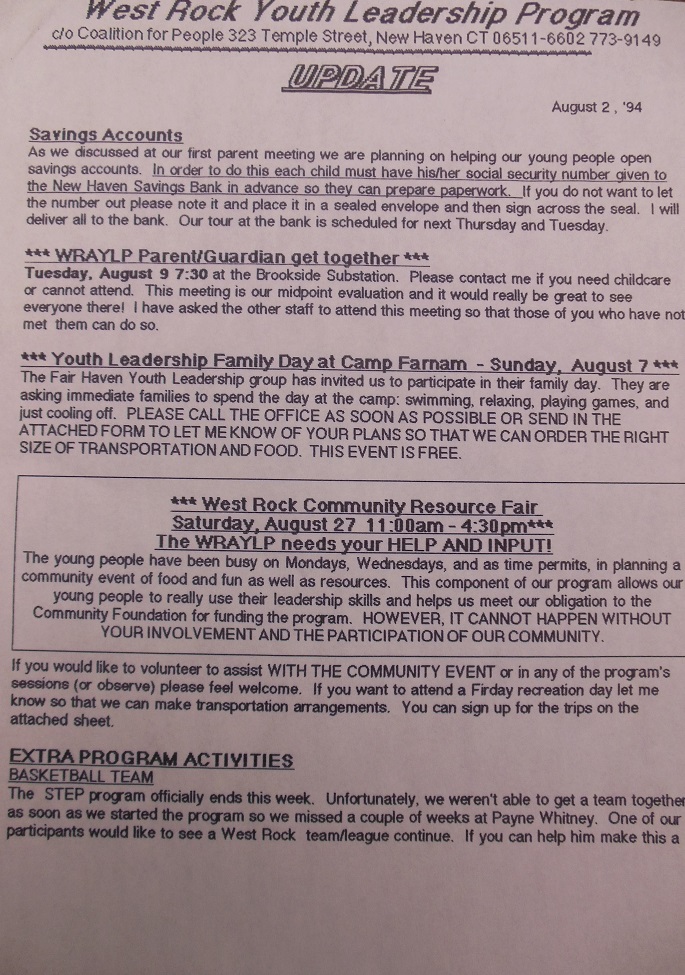
The program was just as much an opportunity for parent involvement as for involvement by the teenagers. Coalition for People regularly sent updates to parents, asking for their help with events and initiatives by the program.

Letter to the parents.

From MS 2007, Box 19, Folder 2.

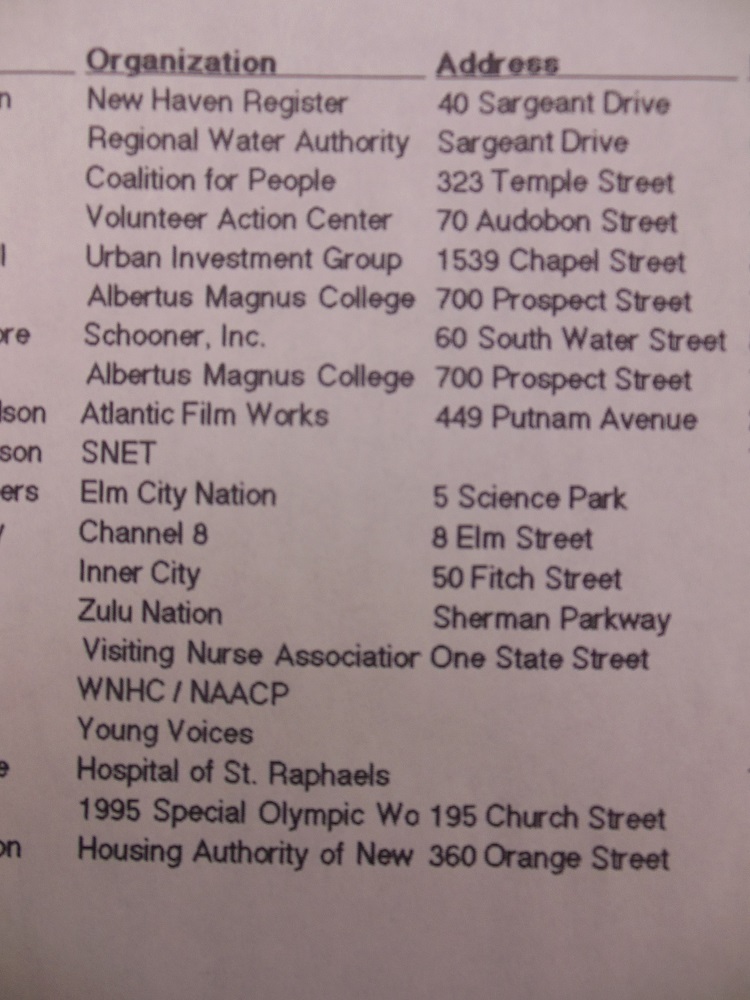
For the mentorship aspect of the program, the Coalition worked hard to get a large variety of businesses to participate, as can be seen from this list of prospective mentors.

Prospective mentor list.

From MS 2007, Box 19, Folder 9.

Part of the program was planning a community event for the neighborhood. The members of the program chose to host a community fair, with games, food, and tables with representatives from different groups that could provide resources for the community. The adolescents in the program sent out this letter to groups to ask for help.

Letter for the community fair.

From MS 2007, Box 19, Folder 5.

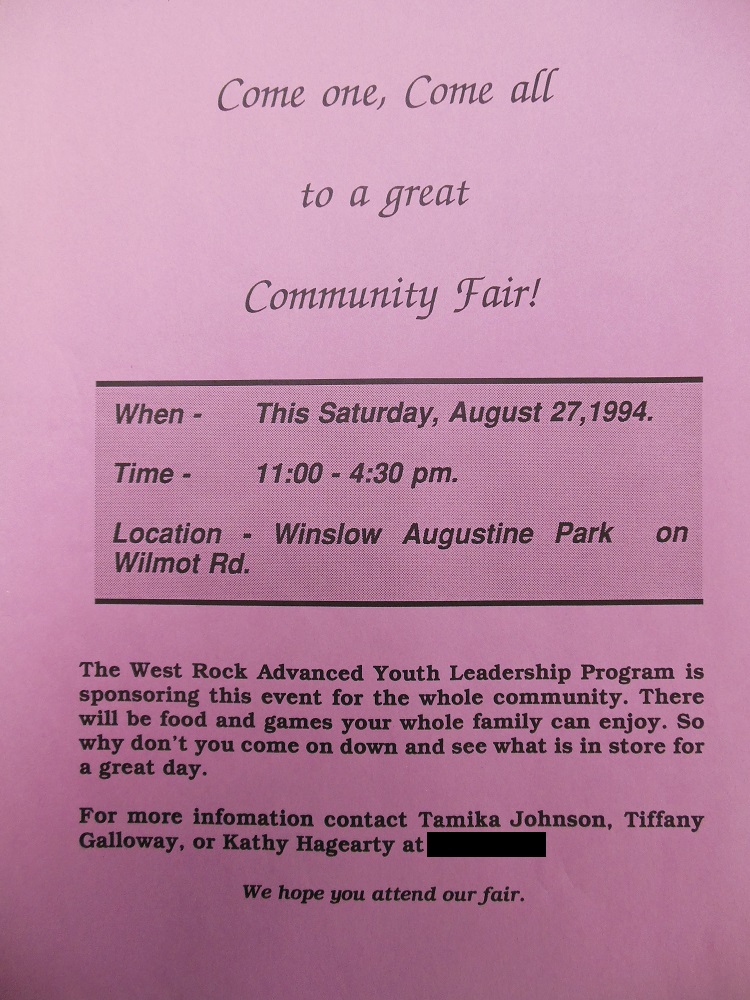
The Community Fair came together on August 27, 1994. By then, the 20 teenagers who participated had gotten a chance to observe, ask questions, and work with role models, take classes, and enjoy day trips that could be as simple as going to the local water park to trips to other cities to see what their museums offered. It is clear that the Coalition had worked hard to help these teenagers. It is equally clear that these teens had a lot to offer.

Flier for the community fair.

From MS 2007, Box 19, Folder 5.

Researchers wishing to work with the Greater New Haven Coalition for People Records can view the finding aid here. Researchers can also visit our website for more information on visiting Manuscripts and Archives and using our collections.

Humor in the Court: The Edward R. Becker Papers

Recently in Manuscripts and Archives, work was completed on the Edward R. Becker Papers (MS 1929). Judge Becker was a Yale Law School alumnus who served in two federal courts, the District Court of Eastern Pennsylvania and Court of Appeals, Third Circuit. He was renowned for his due diligence on cases and his voluminous opinions that could range up to hundreds of pages. He was referred to as the “101st senator” by friend Arlen Specter for the amount of influence he had on legislation, especially with his work on compensating victims of asbestos. He was also devoted to many civic causes, especially those involving the preservation of Philadelphia’s history and making it accessible to all. While all of this is apparent in his papers, I couldn’t help but notice something else engaging: Becker and his colleagues’ sense of humor.

For instance, Matsushita v. Zenith Radio Corp was one of Judge Becker’s cases when he was with the District Court of Eastern Pennsylvania, and the one that made his reputation as an expert in antitrust law. It was a very lengthy case for the court, starting in 1974 and finally reaching a judgment in 1981. After working with it for so long, I’m sure Becker and the other judges were getting rather tired with it. That might explain how a court order was written for “a period of relaxation” in the form of a softball game between the plaintiffs and the defendants, with the only instances of inclement weather allowed to stop the game being “blizzard, volcanic eruption, small pox epidemic, or invasion of the body snatchers.”

First page of the "Softball Order" memorandum

First page of the “Softball Order” memorandum. (MS 1929, Box 9, Folder 6)

The second page of the "Softball Order" memorandum.

Second page of the “Softball Order” memorandum. (MS 1929, Box 9, Folder 6)

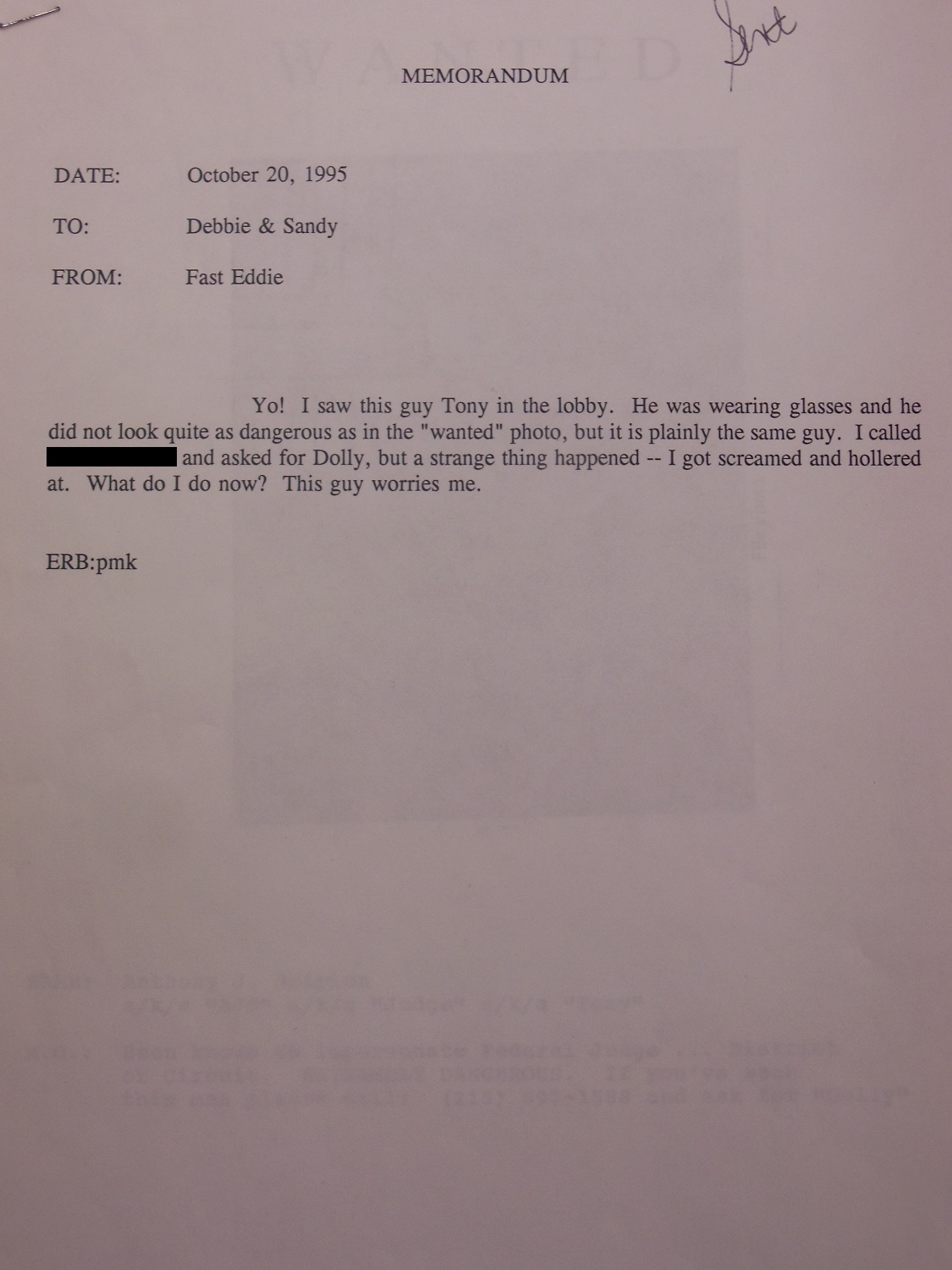
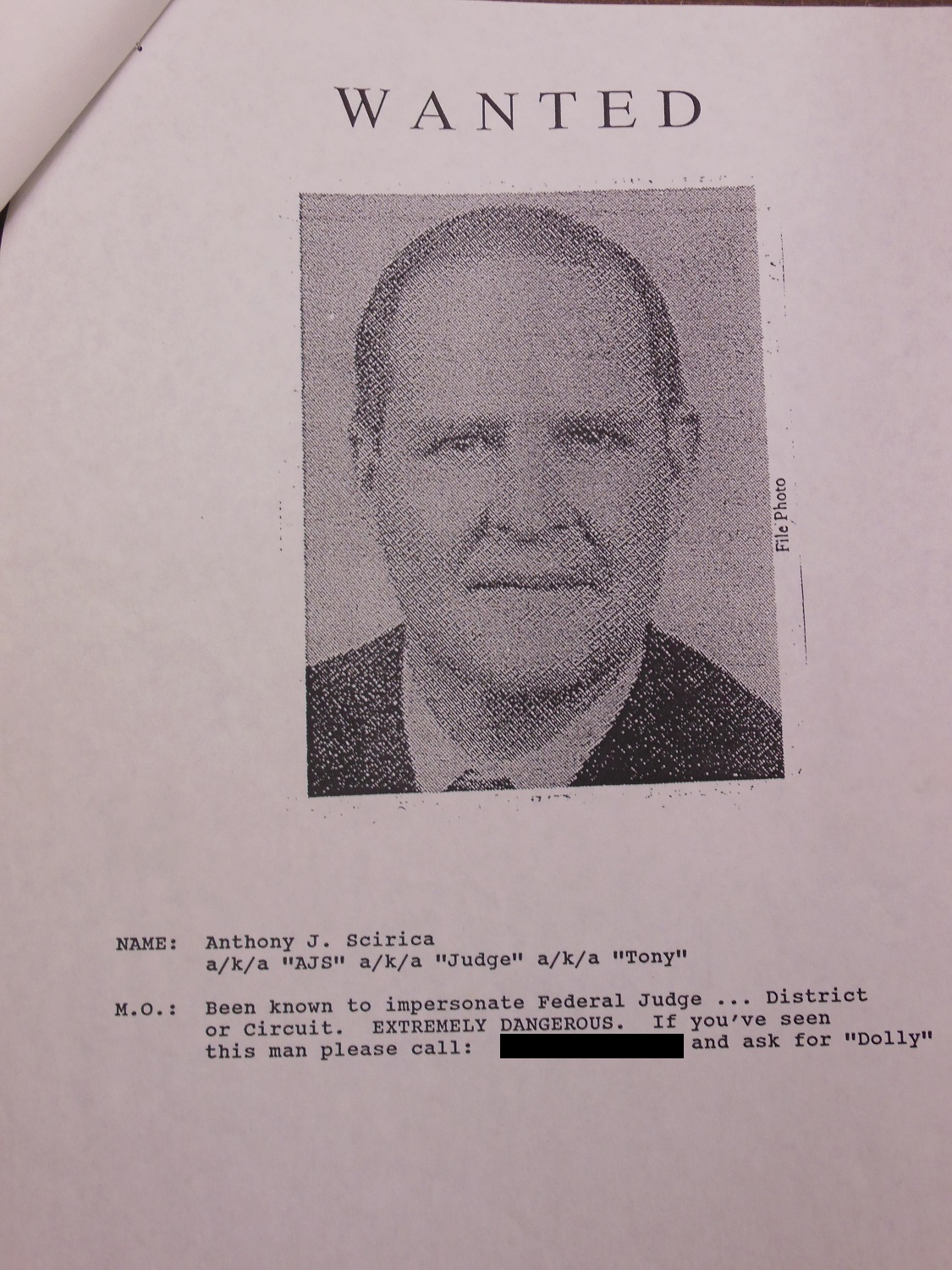
Humor was not only reserved for court business. The judges delighted in making digs at each other as can be seen in their memorandums and related documents. In this October 20, 1995 memo, Judge Becker had sent out a memo with a wanted poster attached picturing a fellow judge, Anthony J. Scirica, saying he had seen him in the lobby and how “this guy worries me.”

Judge Becker expressing his "worries" about "this guy Tony."

Judge Becker expressing his “worries” about “this guy Tony.” (MS 1929, Box 16, Folder 1)

The "dangers" of Judge Scirica.

The “dangers” of Judge Scirica. (MS 1929, Box 16, Folder 1)


Judge Becker was not the only one with a sense of humor. Another correspondent known only as “Bernice” from Washington D.C. told him about her frustration with her day being lifted by his jokes. She was no slouch at cracking jokes either as demonstrated by the puns that keep the note going.


Note to Judge Becker with political puns.

Not only full of puns, but an excellent primer in political figures. (MS 1929, Box 2, Folder 6)

The Edward R. Becker Papers is now available for research and the finding aid can be viewed here. You can also visit our website to learn more about our collections and services, including how to request materials located in our finding aids.